

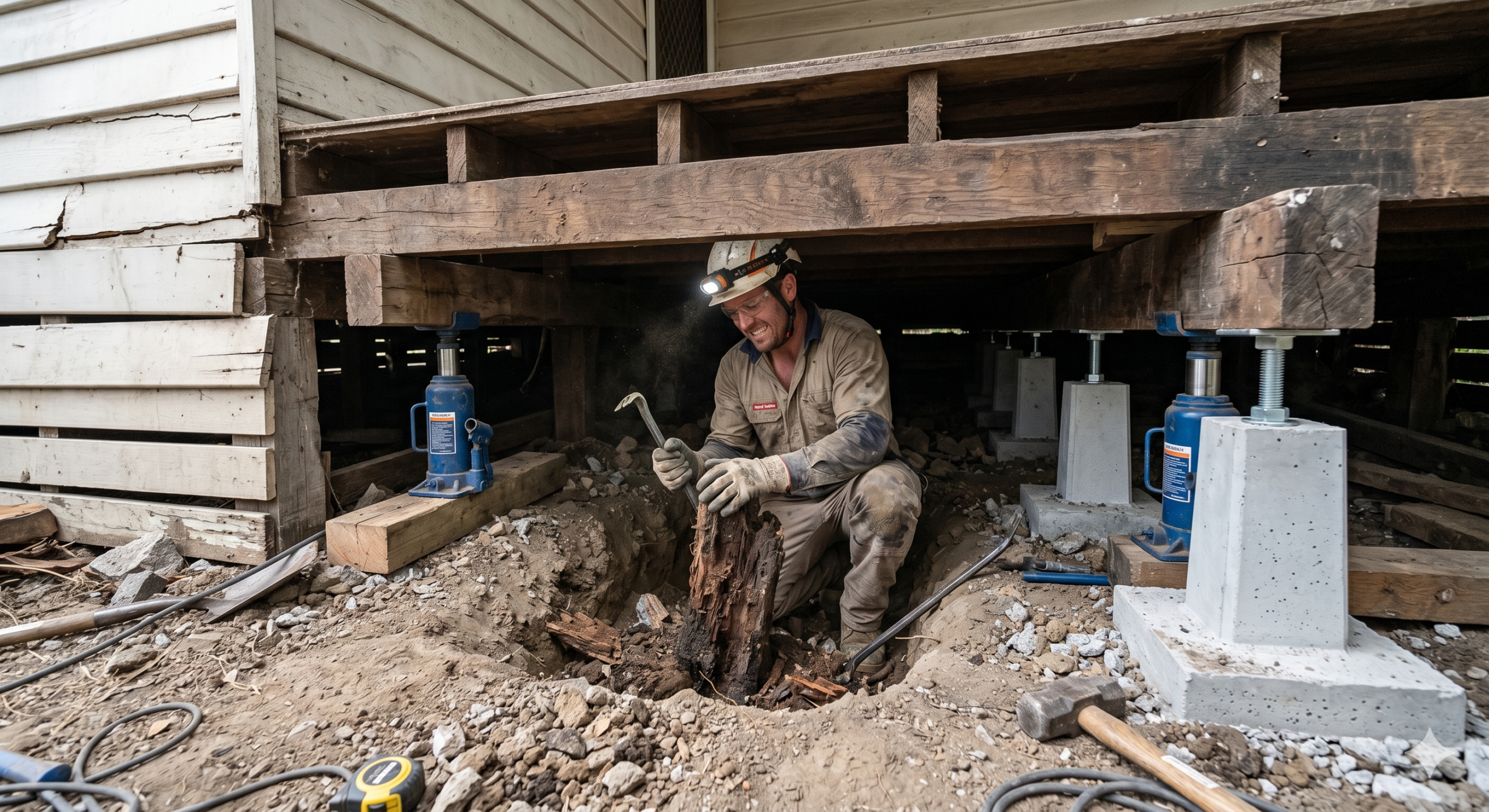

House foundation repair is one of the most critical — and most frequently overlooked — structural concerns facing Melbourne homeowners in 2026. Whether you have noticed sloping floors, sticking doors, cracks spreading across your walls, or a subtle bounce underfoot when you walk through certain rooms, these are rarely cosmetic problems. They are early signals of foundation movement, and in Melbourne’s reactive clay soil conditions, they escalate faster than most homeowners expect. This guide covers everything you need to know: what causes foundation failure, how to recognise the warning signs early, the real difference between underpinning and reblocking, what foundation repairs realistically cost in Melbourne, and how the team at VIC Wide manages the entire repair process from the first free inspection through to the final walkthrough.
Melbourne’s Reactive Clay Soil — Why Your Foundation Is Under Constant Pressure
Melbourne is built on some of the most reactive clay soil in Australia. Unlike sandy or loamy soils, reactive clay changes volume dramatically in response to moisture. In summer, extended dry periods cause the clay to shrink and crack. In winter and spring, heavy rainfall causes it to swell and expand. This cycle repeats every single year — placing continuous stress on your home’s foundation, subfloor stumps, and concrete footings without pause.
Melbourne’s inner suburbs — Carlton, Brunswick, Footscray, Yarraville, and Kew — are particularly affected. Many homes in these areas were built between the early 1900s and the 1970s on timber stumps that were appropriate for their time but were never engineered to withstand decades of ongoing reactive soil movement. The result is gradual but compounding structural deterioration that eventually demands professional attention.
According to the Victorian Building Authority (VBA), soil reactivity is one of the primary contributing factors to foundation distress across Victoria. Understanding this context is essential before choosing any repair approach — because the right solution depends heavily on what the ground beneath your home is actually doing.
What Destroys a House Foundation Over Time?
Foundation failure in Melbourne rarely happens overnight. It is almost always the result of multiple contributing factors working together over months or years. Understanding the causes helps homeowners make informed decisions about when and how to act.
Reactive Soil Shrinkage and Swelling
Melbourne’s clay soils expand when wet and contract when dry — a seasonal cycle that places continuous lateral and vertical force on stumps, footings, and concrete foundations, gradually destabilising them over time. This is the single most prevalent cause of foundation movement across Melbourne’s inner and middle suburbs.
Poor Subfloor Drainage and Moisture Accumulation
Water pooling beneath the subfloor — from inadequate site drainage, faulty plumbing, or poor land grading — accelerates timber stump decay and weakens concrete over time. Sustained subfloor moisture is one of the fastest pathways to compromised structural integrity in older Melbourne homes.
Ageing and Deteriorated Timber Stumps
Homes built before the 1980s typically rest on untreated timber stumps. These stumps absorb moisture, are highly susceptible to white ant (termite) damage, and simply rot with age. Once stumps begin to deteriorate, the floor frame above them loses its even support — producing the visible symptoms most homeowners eventually notice and can no longer ignore.
Tree Root Intrusion
Large trees planted close to older Melbourne homes — particularly in established suburban areas like Kew, Brunswick, and Carlton — can drive root systems beneath the subfloor, physically displacing stumps and footings from below. This is a frequently underestimated and misdiagnosed cause of localised, uneven foundation movement.
Inadequate Subfloor Ventilation
Without sufficient airflow beneath the subfloor, moisture accumulates rapidly. The Australian Building Codes Board (ABCB) sets clear requirements for subfloor ventilation under the National Construction Code — but many older Melbourne homes fall well short of these standards, creating conditions that silently damage the foundation year after year.
Warning Signs Your Melbourne Home Needs Foundation Repairs
Many homeowners don’t recognise that their foundation is failing until the symptoms become severe. Early-stage foundation movement can look almost identical to normal house ageing — which is why so many cases go unaddressed for years while the damage compounds. The following signs warrant immediate professional assessment:
Foundation Warning Signs — Do Not Ignore These
- Uneven or sloping floors — Floors that visibly slope toward one side of the room, or feel noticeably different underfoot between areas, indicate subfloor support has shifted.
- Bouncy or springy floors — A flex or bounce when walking across certain floor areas is a clear sign of failing stump support beneath the floor frame.
- Cracks in walls or ceilings — Diagonal cracks from window and door corners, horizontal brick cracking, or stair-step cracking in mortar joints are structural red flags that go beyond cosmetic settling.
- Doors and windows that stick — When door frames and window openings rack out of square due to foundation movement, doors and windows begin to bind, stick, or fail to latch properly.
- Visible gaps between floors and walls — Separation at the skirting board line or between floor boards and internal walls indicates the floor frame has dropped or shifted beneath you.
- Homes built before the 1980s — If your Melbourne home was built before approximately 1980, a proactive foundation inspection is advisable even without obvious symptoms, as timber stumps from this era are well past their typical service life.
If your home shows two or more of these signs, the right next step is a professional structural inspection in Melbourne — not a wait-and-see approach. Foundation issues do not self-correct, and delaying action consistently increases the total scope and cost of eventual repair.
Underpinning vs Reblocking — Understanding the Difference
One of the most common points of confusion for Melbourne homeowners is whether their home needs underpinning or reblocking. These are related but distinct solutions that address different components of the foundation system. Choosing incorrectly — or delaying either — compounds the damage and the eventual cost of repair.
| Feature | Underpinning | Reblocking / Restumping |
|---|---|---|
| What it addresses | Failed or insufficient concrete footings beneath the home | Deteriorated timber or concrete stumps beneath the subfloor frame |
| Method | New concrete underpins are installed beneath existing footings to extend their depth and bearing capacity | Old stumps are removed and replaced with new concrete stumps at the correct height |
| Best suited for | Significant soil movement, slab foundations, load-bearing wall failure, or where original footings have moved | Homes on timber stumps, pre-1980s construction, and subfloor settlement caused by stump decay |
| Common Melbourne suburbs | Footscray, Yarraville, Kew, Carlton | Brunswick, Carlton, Footscray, Yarraville, and the wider inner west and inner north |
| Permit requirements | Generally required under Victorian Building Regulations — VIC Wide manages this | Required in most cases — VIC Wide handles the permit process on your behalf |
In practice, some Melbourne homes require both underpinning and reblocking — particularly where original footings have also moved in addition to stump deterioration occurring independently. A thorough site inspection is the only reliable way to determine what your specific home actually needs. VIC Wide provides free on-site foundation inspections across Melbourne with no obligation.
House Restumping and Reblocking in Melbourne — What the Process Involves
House restumping — also widely referred to as reblocking or house reblocking across Victoria — is the process of replacing the deteriorated stumps that support the subfloor frame of a timber-framed home. It is a structural necessity for thousands of Melbourne homes built before the 1980s, not an optional cosmetic upgrade.
When stumps begin to fail, the floor frame they carry loses its level bearing surface. This is what triggers the cascade of symptoms homeowners experience — sloping floors, spreading wall cracks, sticking doors, and visible gaps at skirting boards. Professional reblocking in Melbourne restores the structural support beneath the floor frame, returning the home to a stable and structurally sound condition.
Timber Stumps vs Concrete Stumps — Which Is Better for Melbourne?
When restumping a Melbourne home, the choice of replacement stump material has significant long-term consequences. Untreated timber stumps — the type originally installed in most pre-1980 Melbourne homes — have a typical lifespan of approximately 25 to 40 years under normal subfloor conditions, and considerably less where persistent moisture is present. Modern concrete stumps, by contrast, are far more resistant to moisture ingress, termite damage, and reactive soil movement. In most Melbourne restumping projects, concrete stumps are the preferred and more durable choice.
Floor Levelling Melbourne — When It Is Needed and How It Works
Floor levelling is a closely connected process to reblocking and underpinning — and is often carried out as an integrated part of the same repair project. When subfloor stumps have failed or settled unevenly, the floor boards above them follow suit, creating sloped or uneven surfaces that are both uncomfortable to live with and structurally problematic over the longer term.
Effective floor levelling in Melbourne requires the home to be temporarily raised using hydraulic jacks, allowing deteriorated stumps to be replaced at the correct and consistent height. This process restores the floor to a level plane — improving daily liveability while eliminating the structural stress caused by an unsupported floor frame that has been carrying uneven loads for years.
It is worth noting that surface-applied floor levelling compounds — commonly suggested as a quick cosmetic fix — do not address the underlying structural issue. They may temporarily smooth an uneven surface but will not prevent further movement if failing stumps or foundations are left untreated beneath the floor. Genuine house levelling in Melbourne requires working at the subfloor level, not at the surface above it.
How Much Does House Foundation Repair Cost in Melbourne?
Cost is almost always the first question homeowners ask — and also one of the hardest to answer accurately without a proper on-site inspection. Foundation repair costs in Melbourne vary considerably depending on the type of repair required, the number of stumps or underpins involved, access conditions beneath the home, and the extent of secondary damage to the floor frame and surrounding structure.
| Repair Type | Typical Melbourne Cost Range | Key Variables |
|---|---|---|
| Partial Reblocking (select stumps only) | $3,000 – $9,000 | Number of stumps replaced, access, stump material |
| Full House Restumping | $10,000 – $25,000+ | Home size, total stump count, floor frame condition |
| Underpinning (per underpin point) | $500 – $1,500 per point | Soil depth, site access, number of underpins needed |
| Full Underpinning Project | $12,000 – $40,000+ | Footing depth, site complexity, affected wall length |
| Floor Levelling (combined with restumping) | Typically included in restumping scope | Floor frame condition, number of levelling points |
| Free On-Site Structural Inspection | Free with VIC Wide | — |
Note: Cost ranges above are indicative guides based on typical Melbourne project data as of 2026. Accurate pricing for your specific home requires an on-site inspection. VIC Wide provides detailed written quotes with no hidden costs — contact our team to arrange your free assessment.
The VIC Wide Foundation Repair Process — From Inspection to Completion
Understanding how professional house foundation repair actually works removes much of the uncertainty homeowners feel when facing structural work. VIC Wide follows a transparent five-stage process — designed to keep you informed and confident at every step, with no surprises along the way.
Thorough Subfloor Inspection
We physically inspect every part of your subfloor — checking every stump, bearer, joist, and slab section for signs of failure, rot, movement, or damage.
Root Cause Diagnosis
We identify not just what has failed, but why it failed — whether it’s age, moisture, soil movement, inadequate original construction, or termite damage. This prevents the same problem recurring.
Clear Repair Recommendation
We explain our findings in plain English and provide a specific, itemised quote for only the work that’s necessary. No pressure, no upselling.
Targeted Repair Works
Our team carries out the precise repairs with minimal disruption. We replace only what’s failed and leave everything else undisturbed.
Prevention Recommendations
We advise on any drainage, ventilation, or maintenance steps that will protect your repaired foundation and maximise its lifespan going forward.
Foundation Repairs Across Melbourne — Suburbs We Regularly Service
VIC Wide carries out house foundation repair, underpinning, and reblocking across metropolitan Melbourne. Our team has extensive on-the-ground experience in Melbourne’s inner and middle suburbs — understanding the specific soil profiles, housing stock characteristics, and structural challenges unique to each area.
Foundation Repairs Carlton Melbourne
Carlton’s terrace houses and single-fronted Victorian homes are among the most common candidates for foundation repairs in Carlton. Many were built on timber stumps now well past their service life. Narrow access, party walls, and heritage overlays add complexity — but our team has extensive local experience navigating these particular conditions efficiently.
Foundation Repairs Brunswick Melbourne
Brunswick’s high concentration of pre-war housing makes it one of Melbourne’s most active areas for reblocking and underpinning work. Underpinning in Brunswick and full restumping projects form a regular and significant part of our workload — particularly on properties where decades of reactive clay movement have been compounding without correction.
Foundation Repairs Footscray Melbourne
Footscray’s older housing stock — much of it on low-set timber stumps — is highly susceptible to subfloor moisture accumulation and accelerated stump deterioration. Reblocking in Footscray and the surrounding Maribyrnong area properties is a core and ongoing part of the VIC Wide service offering across Melbourne’s inner west.
Foundation Repairs Yarraville Melbourne
Yarraville homeowners regularly contact us regarding uneven floors and sticking doors — classic, reliable indicators of stump movement in this characterful inner-west suburb. Our foundation repair work in Yarraville typically involves a combination of partial or full reblocking with integrated floor levelling.
Foundation Repairs Kew Melbourne
Kew’s larger period homes on established blocks frequently experience foundation issues related to mature tree root systems and pronounced seasonal soil movement. Underpinning in Kew is more frequently required here due to the heavier structural loads that larger homes place on their original footing systems.
Can You Repair a Foundation Yourself — And When Is the Best Time to Act?
Is DIY Foundation Repair Safe or Legal in Victoria?
Foundation repair is not a DIY undertaking in Victoria. Structural work beneath a home — including any form of underpinning, restumping, or subfloor jacking — is regulated under the Building Act 1993 (Vic) and requires a building permit in most circumstances. Unlicensed structural work can void your home insurance policy, create serious and ongoing safety hazards for occupants, and create significant legal and financial complications when you eventually come to sell the property. Always engage a licensed and insured foundation repair specialist for any subfloor structural work.
What Is the Best Time of Year for Foundation Repair in Melbourne?
In Melbourne’s climate, late autumn — April through May — and early spring — September through October — tend to be the most stable periods for foundation repair. During these shoulder seasons, soil moisture levels are moderate and reasonably consistent, giving the most accurate picture of the home’s settled position and making it easier to achieve stable, lasting levelling results. That said, urgent foundation issues should never be delayed to wait for an ideal season. VIC Wide operates year-round and will advise on the optimal timing and approach for your home’s specific condition.
Are There Alternatives to Foundation Repair?
This question comes up frequently — usually from homeowners hoping to avoid the cost and disruption of structural work. The honest answer is straightforward: for genuine foundation failure, there are no safe or effective long-term alternatives.
Some homeowners consider soil stabilisation injections, surface-applied levelling compounds, or cosmetic remediation like re-hanging doors and filling cracks with filler. These approaches can temporarily improve the appearance of a failing structure, but they do not address the underlying cause of the movement. Foundation deterioration will continue — and often accelerate — if the root cause remains unresolved beneath the floor.
That said, not every crack or uneven floor indicates emergency-level foundation failure. A professional structural inspection in Melbourne will assess the true severity accurately — distinguishing between minor cosmetic movement, slight settlement that can be monitored, and active structural failure that requires immediate repair. Getting an expert assessment is always the right first move before spending money on any kind of intervention. The CHOICE Australia consumer guide on building inspections recommends always obtaining a written, itemised inspection report before committing to foundation work of any kind — a standard that VIC Wide applies to every job we undertake.
Preventative Maintenance — Protecting Your Melbourne Foundation Long Term
Once house foundation repair work is complete, the goal is to protect that investment and extend the life of the repaired structure as long as possible. Melbourne’s reactive clay conditions do not change — but their ongoing impact on your foundation can be significantly reduced with the right maintenance habits consistently applied.
- Ensure correct ground slope and surface grading — Ensure that the ground, paving, and garden beds immediately adjacent to the home slope away from the foundation perimeter by at least 50–70mm over the first metre. This prevents water from pooling against the walls and saturating the reactive clay unevenly.
- Manage subfloor drainage actively — Ensure stormwater and rainwater cannot pool beneath or adjacent to your subfloor. Direct all downpipes and stormwater outlets well away from the house perimeter and check them after heavy rainfall.
- Keep subfloor ventilation clear year-round — Check that all subfloor vents are free of obstruction, debris, and garden overgrowth. Adequate airflow is critical to preventing the moisture accumulation that accelerates timber stump decay.
- Control large tree placement near the home — Avoid planting species with aggressive root systems close to your home’s perimeter. If mature trees already exist in proximity, have their relationship to the foundation assessed as part of your next inspection.
- Schedule periodic professional inspections — For older Melbourne homes — particularly those built before 1980 — a professional subfloor and foundation inspection every five to seven years is a sensible and cost-effective investment in early problem detection.
Frequently Asked Questions — House Foundation Repair Melbourne
Conclusion — Don’t Let Foundation Problems Grow Bigger Than They Need To
House foundation repair is not a situation where waiting ever works in your favour. Melbourne’s reactive clay soils, ageing pre-1980 housing stock, and seasonal moisture extremes create persistent conditions for foundation movement to progress steadily — often invisibly — until the symptoms become impossible to ignore and the repair scope has grown significantly larger than it needed to be.
Whether your home is showing early warning signs like bouncy floors and sticking doors, or you’re dealing with visible wall cracks and sloping floors that have been getting progressively worse over a number of years, the right next step is a professional assessment. Not a guess, not a quick cosmetic fix, and not another season of watching and waiting — a proper, expert-led inspection that gives you a clear and honest picture of what is happening beneath your home and what it will realistically take to fix it.
VIC Wide provides free on-site foundation inspections across Melbourne — covering underpinning, reblocking, restumping, floor levelling, and full structural assessment for homes across Carlton, Brunswick, Footscray, Yarraville, Kew, and the wider Melbourne metropolitan area. Every job comes with a plain-English explanation of the findings, a detailed written quote with no hidden costs, and a team that treats your home with the care and respect it deserves throughout the entire repair process.