

If you own a timber-framed home in Brunswick, house reblocking Brunswick Melbourne should already be on your radar — particularly if your property was built before the 1980s. Melbourne’s inner north is filled with weatherboard and brick-veneer homes resting on timber stumps that have been quietly deteriorating for decades beneath the floor. When those stumps fail, the consequences spread fast: floors begin to slope, doors jam in their frames, cracks appear across walls and ceilings, and the structural integrity of the entire home is compromised. Ignoring it doesn’t slow the process down — it accelerates it.
Reblocking — also known as restumping throughout Victoria — is the process of replacing old, rotted, or failed subfloor stumps with new concrete or treated timber stumps. It is one of the most structurally important repairs a Melbourne homeowner can carry out. This guide explains the warning signs, the reblocking process, what it costs, how it compares to underpinning, and why Brunswick and surrounding inner Melbourne suburbs are particularly vulnerable to stump deterioration.
Whether you have noticed uneven floors at home, are purchasing a pre-1980s property in Brunswick, or simply want to understand what is happening beneath your house, this guide gives you a complete picture — from first inspection through to a fully levelled, restabilised home.
And Those Stumps Don’t Last Forever
Melbourne’s inner suburbs — Brunswick, Carlton, Footscray, Yarraville, and beyond — are filled with timber-framed homes built between the early 1900s and the 1970s. These homes rest on timber stumps that were built to last, but not indefinitely. Melbourne’s reactive clay soils, seasonal moisture changes, and decades of subfloor exposure gradually take their toll on even the most solidly built foundations.
Reblocking — also referred to as restumping throughout Victoria — is the process of replacing deteriorated or failed stumps beneath a home’s subfloor frame with new concrete or treated timber stumps. It is a structural necessity, not an optional upgrade. Without healthy stumps in place, the entire floor frame begins to sag, shift, and settle unevenly — triggering a cascade of damage that spreads upward into walls, door frames, window reveals, and internal linings.
The difficulty is that most homeowners don’t recognise how far the deterioration has progressed until the physical symptoms become impossible to ignore. This guide explains exactly what to look for, when to act, and what professional reblocking in Melbourne looks like from the first inspection through to the completed repair.
Melbourne Soil Conditions — Why They Accelerate Stump Deterioration
Melbourne is built predominantly on reactive clay soils. These soils expand when wet and contract when dry — a cycle that repeats across every season. This constant ground movement places ongoing stress on subfloor stumps, particularly older untreated timber stumps that were never designed for this level of long-term ground activity. Brunswick, Carlton, Fitzroy, and surrounding inner-suburban areas are particularly prone to this pattern of reactive soil movement.
During periods of drought or prolonged dry weather — common across Melbourne summers — the clay contracts and pulls away from foundations. When heavy rain arrives, the clay swells back. This rhythmic expansion and contraction causes stumps to shift, lean, or sink unevenly. Over time, even structurally sound stumps can be driven out of alignment simply by the movement of the soil around them.
Older untreated timber stumps deteriorate even faster under these conditions. Moisture from the reactive clay penetrates the timber, accelerating rot, fungal decay, and structural weakening from below ground level — often invisibly, until a stump physically fails and the floor above it begins to drop.
Melbourne Soil Fact: The Victorian Building Authority confirms that reactive clay soils are widespread across metropolitan Melbourne and are a primary contributing factor to foundation movement, stump deterioration, and structural settlement in pre-1980s timber-framed homes. Learn more at the Victorian Building Authority.
Warning Signs Your Brunswick Home Needs Reblocking
Many homeowners don’t realise their stumps are failing until the symptoms become severe. The earlier you identify the warning signs, the less structural damage accumulates — and the lower your overall repair costs. Watch out for these indicators in your Brunswick or inner Melbourne home:
- Uneven or noticeably sloping floors — particularly floors that have changed over time
- Bouncy, springy, or soft spots underfoot when walking across the floor
- Diagonal cracks spreading from the corners of door frames or window openings
- Doors and windows that have started sticking, jamming, or are difficult to close
- Visible gaps developing between the floor and skirting boards along the wall
- Cracks appearing in internal plasterwork, particularly along ceiling lines or wall junctions
- A noticeable lean or slope when standing at one end of a room and looking toward the other
- Your home was built before 1980 and has never had a subfloor inspection or reblocking carried out
If you have identified any of these signs in your home, the appropriate next step is a professional foundation inspection in Brunswick or Melbourne. Attempting to assess stump condition yourself without subfloor access and experience rarely gives an accurate picture of the actual deterioration beneath the floor.
Reblocking vs Underpinning — Understanding the Difference
This is one of the most frequently asked questions by Melbourne homeowners dealing with structural movement. Reblocking and underpinning in Melbourne both address foundation problems, but they apply to fundamentally different structural systems.
| Feature | Reblocking / Restumping | Underpinning |
|---|---|---|
| Applies to | Timber-framed homes on stumps | Homes on concrete slab or strip footings |
| Process | Replace failing subfloor stumps | Extend or reinforce existing footing depth |
| Common cause | Stump rot, soil movement, age | Soil subsidence, footing failure, reactive clay |
| Melbourne relevance | Very high in pre-1980s inner suburbs | High in newer slab construction on reactive clay |
| Outcome | New stumps restore floor level and structure | Reinforced footings stabilise the slab foundation |
Both processes address the same fundamental problem — a compromised foundation — but the correct solution depends entirely on how your home is built. A professional structural assessment is always the first step, because applying the wrong repair method wastes money and can cause further structural complications. VIC Wide carries out thorough on-site assessments before recommending any approach, ensuring the right solution for your specific home and subfloor conditions.
Concrete Stumps vs Timber Stumps — What’s the Best Choice for Melbourne Homes?
When carrying out house reblocking in Melbourne, one of the most important decisions is the choice of replacement stump material. Both concrete stumps and treated timber stumps are used, and each has distinct advantages depending on the property’s subfloor conditions and budget.
Concrete Stumps
Concrete stumps are the most commonly specified replacement stump material for Melbourne reblocking projects. They are highly durable, resistant to moisture and termite attack, and unaffected by the fungal decay that destroys untreated timber over time. Concrete stumps have a significantly longer service life than timber and are particularly well suited to Melbourne’s reactive clay subfloor conditions, where ongoing ground movement and moisture cycling are the norm. For most Brunswick homeowners, concrete stumps represent the most cost-effective long-term investment.
Treated Timber Stumps
Modern treated timber stumps — specifically H5-rated hardwood or pine — are pressure-treated with preservatives that provide substantial resistance to rot and termite attack. While not as long-lived as concrete under Melbourne’s reactive soil conditions, treated timber stumps remain a practical option where site conditions or access constraints make concrete installation difficult, or where budget is a primary consideration.
Your reblocking contractor should clearly explain the relative merits of each option for your specific property and soil conditions before work begins. VIC Wide provides this guidance as part of the free on-site inspection process — in plain English, with no unnecessary jargon.
The VIC Wide Reblocking Process — Step by Step
Understanding what actually happens during a professional reblocking job removes a great deal of uncertainty for homeowners. VIC Wide follows a structured, transparent process on every Brunswick and Melbourne reblocking project — with no hidden steps and no unexpected costs.
Free On-Site Inspection
Our team comes to your Brunswick home at no cost and thoroughly inspects your foundation, stumps, and subfloor structure for any issues. We examine stump condition, floor levels, soil conditions, and any visible structural symptoms above the floor — giving you a complete and accurate picture of what is happening beneath the house.
Detailed Written Assessment
We explain everything we found in plain English — no confusing jargon, no vague estimates. You will understand exactly what is happening structurally, why it happened, and precisely what needs to be done to fix it properly.
Clear Written Quote
You receive a fully itemised written quote with no hidden costs. We break down the scope of work, stump quantities, materials, and process so you know exactly what you are paying for before committing to anything.
Temporary Jacking
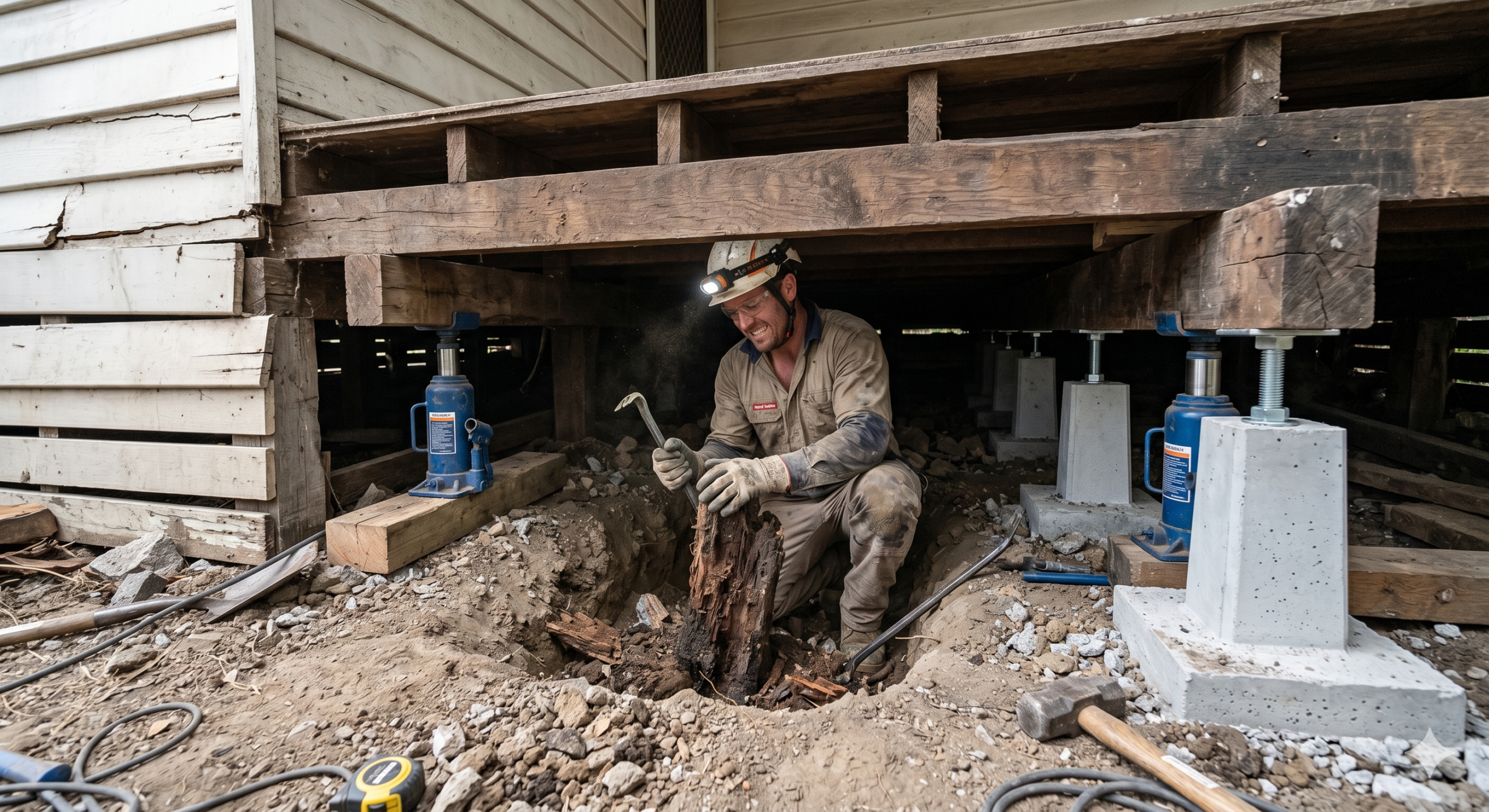
The floor frame is carefully and incrementally jacked to restore it to a level position. This is carried out by experienced tradespeople using calibrated equipment — the process is controlled and measured to avoid introducing new stress into the structure.
New Stump Installation
Failed or deteriorated stumps are removed and replaced with new concrete or treated timber stumps, correctly positioned, bedded, and secured to the bearer system above. All work is carried out to Victorian building standards and relevant permit requirements.
Levelling and Final Checks
Floor levels are checked across the entire affected area. Any final adjustments are made to ensure the floor is as level as possible across the full subfloor span.
Final Walkthrough
We walk you through the completed work, answer any questions, and make sure you are 100% satisfied before we leave. Your home is left tidy and the site is cleaned before our team departs.
Floor Levelling Melbourne — How It Relates to Reblocking
Floor levelling in Melbourne is frequently required as a direct result of stump failure or uneven stump settlement. When stumps at different points beneath the floor have deteriorated at different rates — which is common, since subfloor conditions vary across a property — the result is a floor that has dropped unevenly across multiple points. Some sections sag significantly while adjacent sections remain relatively level, creating a distinct slope or wave pattern across the floor surface.
Professional floor levelling is carried out in conjunction with reblocking — restoring the subfloor frame to a level plane as the new stumps are installed. In some cases where above-slab floor levelling compound is required — for instance, over a concrete section of the home — this is carried out separately as a complementary process. VIC Wide provides floor levelling services across Melbourne as part of a comprehensive foundation repair approach.
Foundation Repairs Brunswick Melbourne — Beyond Just Reblocking
While reblocking addresses stump failure directly, broader foundation repairs in Brunswick Melbourne sometimes involve additional structural work that goes beyond stump replacement alone. Depending on the extent of the damage and how long the problem has been developing, the following elements may also require attention:
- Bearer and joist repair or replacement — the horizontal timber members sitting directly on the stumps can split, crack, or rot where stump movement has placed excessive stress on the joints
- Subfloor drainage improvements — poor drainage beneath a Brunswick home allows moisture to pool in the subfloor, dramatically accelerating stump deterioration and creating conditions for ongoing decay
- Underpinning of footing sections — where a home has a combination of stumped sections and concrete footing sections, underpinning in Melbourne may be needed alongside reblocking to stabilise the entire foundation system
- Crack repair and cosmetic rectification — once the structural foundation is stable, internal wall cracks and plasterwork damage caused by the movement can be properly and permanently repaired
A thorough structural assessment — not just a visual inspection of the stumps — is the only way to determine the full scope of what is needed. VIC Wide’s free on-site inspection covers the complete subfloor and foundation system, not just the most obvious visible damage.
How Much Does Reblocking Cost in Melbourne?
Reblocking cost in Melbourne varies depending on several key factors: the number of stumps being replaced, the stump material selected, the accessibility of the subfloor, the size of the property, and whether additional structural repairs are needed alongside the stump replacement. The following is a general guide based on typical Melbourne residential projects:
| Project Type | Approximate Cost Range | Notes |
|---|---|---|
| Partial reblocking (few stumps) | $3,000 – $8,000 | Limited stump failure, good subfloor access |
| Full reblocking — small home | $10,000 – $18,000 | 3-bedroom home, concrete stumps |
| Full reblocking — larger home | $18,000 – $30,000+ | Larger floor area, difficult access, extensive damage |
| Reblocking + foundation repairs | $20,000 – $40,000+ | Bearer/joist damage, drainage work, combined underpinning |
These are indicative ranges only. The only way to obtain an accurate reblocking cost for your Brunswick or Melbourne home is through a professional on-site inspection and a detailed written quote. Be cautious of any contractor willing to provide a firm quote before inspecting the subfloor in person — the scope of reblocking work cannot be accurately determined remotely or from photographs alone.
For verified information on building costs and consumer rights in Victoria, the Consumer Affairs Victoria building and renovating guide is a reliable starting point.
Buying a Brunswick Home That Needs Restumping — Is It Worth It?
Many Brunswick and inner Melbourne properties — particularly those listed below market value — require reblocking or restumping as part of an upcoming renovation. The question Melbourne buyers frequently ask is whether it is worth purchasing a property with known stump issues.
The honest answer is: it depends entirely on the scope of work required and whether the purchase price reflects the cost of repairs. A home that needs full reblocking but is priced $30,000 below comparable properties in the same street may still represent excellent value — particularly in Brunswick, where property prices consistently outperform Melbourne’s broader market. The critical factor is obtaining a professional foundation inspection in Melbourne before you commit to the purchase.
A pre-purchase subfloor inspection from a qualified reblocking specialist will tell you exactly which stumps have failed, which are at risk, what material replacements are recommended, and a realistic cost of the full repair. Armed with that information, you can negotiate the purchase price accordingly — or walk away if the numbers don’t stack up.
Buyer’s tip: Never rely solely on a standard building inspection report for stump condition assessment. Many general building inspectors identify surface symptoms — sloping floors, wall cracks — but do not carry out a detailed subfloor investigation. Always commission a specialist reblocking or foundation inspection separately before purchasing a pre-1980s Brunswick property.
Does Reblocking Protect Your Property Value?
Unresolved structural foundation problems are among the most significant factors that reduce property value in Melbourne. Buyers and licensed building inspectors identify sloping floors, wall cracking, jammed doors, and subfloor movement almost immediately — and those issues translate directly into reduced offers, failed finance conditions, and deals falling through entirely.
Carrying out professional house reblocking Brunswick Melbourne — before listing a property or as part of a renovation project — not only prevents further structural deterioration but actively restores and in many cases increases the property’s market value. A sound, level, professionally restumped home commands a premium over a comparable property with known foundation issues, particularly in competitive inner Melbourne suburbs like Brunswick, Carlton, and Fitzroy.
Beyond resale value, a structurally stable home is simply safer to live in. Floor collapse risk, door and window failure, and plasterwork damage caused by ongoing stump movement are all preventable with timely reblocking. The longer stump failure is left unaddressed, the greater the cumulative damage — and the higher the eventual repair cost.
Is Reblocking or Restumping Covered by Home Insurance?
This is a question VIC Wide’s team hears regularly from Melbourne homeowners — and the answer requires careful consideration of your specific policy terms. In the majority of cases, standard home insurance policies in Australia do not cover reblocking or restumping when the cause is gradual deterioration, timber decay, age-related wear, or soil movement over time. These are considered maintenance-related issues that fall outside the scope of accidental or sudden damage claims.
However, if stump or foundation damage can be directly attributed to a specific insured event — such as storm flooding, a sudden ground collapse, or significant subsidence caused by a burst water main — it may be possible to lodge a claim. Insurance outcomes vary significantly between providers and policy types.
If you believe an insured event has contributed to your foundation or stump damage, document the damage thoroughly with photographs, obtain an independent professional assessment, and contact your insurer before beginning any repair work. The Australian Financial Complaints Authority (AFCA) provides independent dispute resolution if you believe an insurance claim has been unfairly denied.
Structural Inspections Melbourne — Why They Come First
A structural inspection is the foundation of every sound reblocking or foundation repair decision. Without understanding the full condition of the stumps, bearers, joists, and subfloor frame — as well as the soil conditions beneath — any repair approach risks being incomplete, incorrectly specified, or unnecessarily expensive.
VIC Wide provides free on-site structural inspections for Melbourne homeowners across Brunswick and all surrounding inner suburbs. During the inspection, the team assesses:
- The condition and integrity of all accessible stumps — identifying rot, cracking, lean, and settlement
- Bearer and joist condition — looking for stress fractures, rot, sagging, and joint failure
- Floor levels across the full subfloor span using calibrated levelling equipment
- Subfloor ventilation and drainage conditions — moisture accumulation is a primary driver of stump decay
- Visible structural symptoms above the floor — cracking patterns, door and window movement, and gap formation
The result is a complete, accurate picture of the structural condition of the home — not a surface-level assessment that misses the real extent of the problem. Book your free structural inspection with VIC Wide and know exactly what you are dealing with before making any decisions.
Building Permits for Reblocking in Victoria
In Victoria, reblocking and restumping work generally requires a building permit under the Building Act 1993 (Vic) and the National Construction Code. The permit process ensures that all structural work is carried out to a compliant standard and is inspected at key stages by a registered building inspector.
A reputable reblocking contractor — including VIC Wide — handles the permit application process on your behalf as part of the project scope. Be cautious of any contractor who suggests that reblocking work can be carried out without a permit — this creates significant legal and insurance liability for the homeowner and may affect the property’s title and future sale prospects.
For detailed information on building permit requirements in Victoria, the Victorian Building Authority permit guide is the authoritative reference.
Reblocking and Foundation Repairs Across Melbourne’s Inner Suburbs
The stump deterioration and reactive clay conditions that affect Brunswick homes are found across Melbourne’s broader inner suburban ring. VIC Wide provides professional reblocking, underpinning, floor levelling, and foundation repairs across all of Melbourne’s inner suburbs, including:
- Reblocking Carlton: Carlton’s Victorian-era terrace homes and Edwardian cottages are among Melbourne’s oldest residential stock — many still sitting on their original timber stumps. Reblocking in Carlton is a regular requirement for this housing type.
- Underpinning Carlton Melbourne: Where Carlton homes have concrete footing sections alongside stumped sections, combined reblocking and underpinning approaches are applied to stabilise the full foundation system.
- Reblocking Yarraville: Yarraville’s inner west timber-framed homes face the same reactive clay challenges as Brunswick. Reblocking in Yarraville is increasingly sought by homeowners renovating these character properties.
- Underpinning Footscray Melbourne: Footscray’s rapid residential growth has placed greater attention on foundation condition across the suburb’s older housing stock. Underpinning in Footscray addresses footing movement in both slab and stumped homes.
- Underpinning Kew Melbourne: Kew’s prestigious older homes — many of which are large Victorian and Edwardian properties — require careful, experienced foundation intervention when settlement or stump failure occurs.
- Foundation Repairs Footscray Melbourne: Comprehensive foundation repairs in Footscray address the full spectrum of subfloor and footing damage across the suburb’s mixed residential housing stock.