

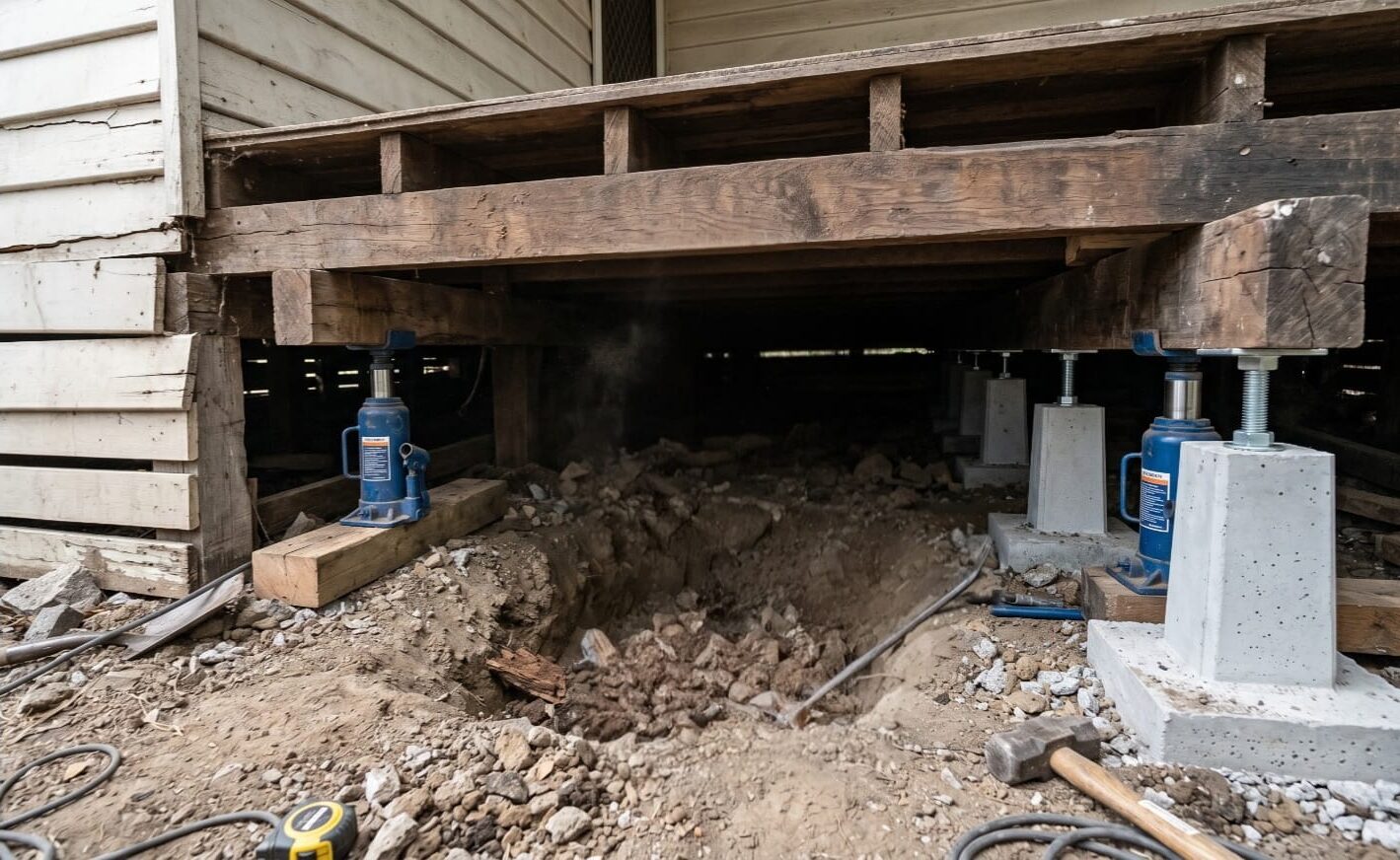

If you are searching for restumping in Box Hill, you may have noticed that a floor feels uneven, a door has started sticking, or a crack has appeared near a window. These changes can be frustrating, especially when you are unsure whether the problem is minor or points to something underneath the house.
Restumping, also known as reblocking, replaces the stumps supporting a raised house when the existing supports need attention. The cost and scope depend on the condition of the supports, access beneath the floor, and any related structural work. This guide explains the warning signs, indicative costs, partial versus full reblocking, permits and the questions to ask before accepting a quote.
Signs Your Box Hill Home May Need Restumping
The supports beneath a raised timber-floor home are easy to overlook because most of them are out of sight. Changes inside the house can be the first reason to investigate what is happening underneath.
Uneven or springy floors
You may notice that a room feels lower at one end, furniture does not sit as expected, or the floor moves more than usual underfoot. Changes in floor level can relate to the stumps, bearers, joists or other parts of the structure. An inspection is needed to identify the cause.
Doors that stick or gaps that change
A door that suddenly rubs against its frame, windows that become harder to open, or gaps appearing near skirting boards may be signs of movement. These symptoms can have several causes, so they should be assessed alongside the condition of the house’s supports.
Cracks in walls or ceilings
New or widening cracks deserve attention, particularly when they occur alongside uneven floors or doors that no longer close properly. A crack alone does not confirm stump failure, but a combination of changes is a good reason to seek professional advice.
Visible stump deterioration
If a safe, accessible view beneath the house reveals timber that appears decayed, damaged or out of alignment, arrange an inspection. Do not crawl into a confined or unsafe subfloor or attempt to test, move or support structural elements yourself.
Why Every Box Hill Property Needs an Individual Assessment
Not every home in Box Hill has the same foundation, condition or maintenance history. Some raised homes have timber stumps; others may have had earlier repairs or different support arrangements. Property age alone cannot tell you how much work is required.
Moisture around the subfloor, poor drainage, termite activity, restricted access and previous repairs may all affect the condition of a particular property. Ground movement can also contribute to changes in the way a structure is supported. These factors need to be considered rather than assuming that every local home has the same soil conditions or stump problems.
A useful assessment identifies the affected supports, considers the surrounding subfloor, and checks whether the observed movement may involve the bearers, joists, or original footings. This also helps determine whether partial restumping, full house reblocking, or a different type of foundation repair should be considered.
How Much Does Restumping Cost in Box Hill?
There is no single price for every property. The number of stumps, the size and weight of the house, the condition of the existing supports and the accessibility of the subfloor can all affect the scope and cost.
Published Melbourne restumping guides reviewed in October 2026 give differing estimates. The following figures are broad comparison ranges from public price guides, not verified Box Hill quotes or a fixed price for your home.
| Indicative project type | Broad published guide range | What needs to be confirmed |
| Partial restumping, around 10–20 stumps | 3,000–15,000 | Number of supports, minimum job charges and associated work. |
| Small home or cottage, around 25–40 stumps | 9,000–16,000 | Actual stump count, materials, access and any additional repairs. |
| Typical three-bedroom home, around 40–65 stumps | 12,000–50,000 across published estimates | The substantial differences between guides, project assumptions and inclusions. |
| Large, period or difficult-access home | 22,000–50,000 or more in some guides | House size, structural complexity, ground conditions and specialised requirements. |
Note: These figures should be treated as an initial reference only. The upper and lower estimates are not necessarily based on identical materials, stump numbers or inclusions. Confirm whether GST, engineering, building surveyor fees, permits and floor repairs are included before comparing any prices.
A partial job usually has a smaller initial scope than a full reblock, but that does not automatically make partial work the best option. The inspection must establish whether a limited repair adequately addresses the problem. The cheapest quote is not necessarily the most comparable quote.
Partial Restumping vs Full House Reblocking
Partial restumping replaces selected stumps, and full house reblocking replaces stumps across the house. The right scope depends on what the inspection finds, not simply on the home’s age or the appearance of one damaged support.
| Consideration | Partial restumping | Full house reblocking |
| Scope | Selected stumps are replaced. | Stumps across the house are replaced. |
| Possible suitability | Deterioration is confirmed to be localised, and the remaining supports are serviceable. | Widespread deterioration or the overall condition justifies a wider replacement. |
| Inspection focus | Affected and surrounding stumps, connections and floor framing. | The full support system, floor levels and related structural conditions. |
| Cost considerations | Number of stumps, access and related repairs. | Total replacement scope, materials, access and related work. |
When may partial restumping be suitable?
Partial restumping may be appropriate when an inspection confirms that deterioration is limited to a specific area and the remaining supports are serviceable. The assessment should still consider nearby stumps, the condition of the floor frame, and whether the proposed work will address the observed movement.
When should full reblocking be assessed?
Full house reblocking may be worth assessing when many supports are deteriorated, problems extend across several parts of the home, or a broader replacement scope is justified by the condition of the subfloor. It should not be recommended simply because the home is old. Ask the contractor to explain the inspection findings behind the proposed scope.
If you are comparing reblocking in Melbourne options, request a written explanation of what will be replaced and what will remain. This is more useful than comparing a partial quote against a full-house quote without checking the difference in scope.
What Affects Restumping Costs?
- Number of stumps: Replacing more supports generally increases labour and material requirements.
- House size and construction: The layout, weight, and support arrangement affect the work involved.
- Subfloor access: Restricted working space may make inspection, removal and installation more difficult.
- Stump materials: The suitable material depends on the structure, design requirements, ground conditions and specifications.
- Ground and drainage conditions: Site conditions may affect footing design, preparation or related work.
- Floor levelling: The amount of adjustment needed and the condition of bearers or joists may change the scope.
- Approvals and additional repairs: Engineering, surveyor fees, permit charges and making good affected areas may need to be allowed for.
Ask for the quote to separate the main replacement work from additional or provisional items wherever practical. If the contractor cannot confirm a cost before opening up the subfloor, ask how unexpected findings and variations will be handled.
What Happens During the Restumping Process?
Although the details vary between properties, the process usually involves several stages.
- Inspection: The condition of the stumps, surrounding supports, and floor frame is assessed, and the proposed scope is discussed.
- Written quote and planning: The contractor documents the work, materials, exclusions, and likely timing. Engineering or other project-specific advice may be required.
- Permits and preparation: The required approvals and inspection arrangements are confirmed before work starts. The relevant building surveyor must be appointed as required.
- Temporary support and replacement: The house is supported using an appropriate method while the specified stumps are replaced.
- Levelling and checks: The completed work is checked against the project requirements, with any required inspections and documentation arranged.
Do not rely on a generic online timeframe as a promise for your property. Duration depends on stump numbers, site access, materials, ground conditions, weather, and required approvals. Ask for an estimated start date and a realistic schedule for the specific job.
Building Permits and Registered Practitioners in Victoria
Restumping and reblocking involve structural work, so it is important to understand Victoria’s building approval and practitioner registration requirements. Individuals carrying out restumping or reblocking must hold the appropriate registration with the Building and Plumbing Commission (BPC), regardless of the project’s value.
Before work begins, confirm the building permit requirements and make sure the relevant building surveyor is appointed. Property owners can use either a municipal or private building surveyor, subject to the applicable appointment requirements. Ask your contractor who will assist with the permit documentation, required inspections and project coordination.
Keep copies of the approved plans, written contract, variations and completion documents for your records. For further information, refer to Consumer Affairs Victoria’s guidance on registered building practitioners and the Building and Plumbing Commission’s guidance on appointing a building surveyor.
How to Compare Restumping Quotes
When comparing house restumping in Melbourne quotes, make sure each contractor is pricing a comparable job. A low figure may cover fewer stumps or leave out costs included in another quote.
Before you agree to proceed, check that the written quote explains:
- Which stumps will be replaced and the proposed materials.
- Whether the work is partial or full reblocking, and why that scope is recommended.
- Whether floor levelling, bearer or joist repairs and making goods are included.
- Who will handle the required permits, inspections and other approvals.
- Whether GST, engineering, surveyor fees and site preparation are included or excluded.
- The estimated schedule, payment terms, warranty conditions and process for variations.
For related information on house foundation repairs, look at the foundation repair service page. For wider structural concerns, underpinning Melbourne may also be relevant, depending on the property’s foundation system.
Frequently Asked Questions About Restumping in Box Hill
Arrange a Restumping Assessment in Box Hill
If you have noticed uneven floors, deteriorated stumps or movement around your home, an assessment can help clarify what needs attention. You do not need to decide between partial restumping and full house reblocking before the inspection.
Also, you may contact the Vic Wide team through the restumping and foundation repair enquiry page to discuss your Box Hill property. Ask for a written scope that explains the proposed work, approvals, inclusions, and exclusions before committing. The goal is to understand the problem and make an informed decision about the next step.