

When it comes to restumping in Melbourne, the contractor you hire matters just as much as the materials they use. Poor workmanship on a foundation job does not just cause structural problems. It can void your warranty, create permit complications, and cost you far more to fix later. Melbourne’s older housing stock — particularly timber-framed homes built before the 1980s — relies heavily on subfloor stumps to distribute structural load. As those stumps age or deteriorate in Melbourne’s reactive clay soils, the consequences show up quickly: sloping floors, sticking doors, cracking walls, and shifting foundations.
Choosing the right company for the job, therefore, is not a small decision. This guide breaks down exactly what to look for in a licensed and insured restumper in Melbourne. It covers how to verify credentials, what your quote should contain, how warranties work, and what red flags should stop you from signing a contract. Whether you need full restumping, partial stump replacement, or a professional subfloor inspection first, this guide gives you the knowledge to make a confident, informed choice.
Verified Fact
In Victoria, restumping is classified as regulated building work under the Building Act 1993 (Vic). It must be carried out by a registered building practitioner. The Victorian Building Authority (VBA) oversees all practitioner registrations and building permits in Victoria.
Signs Your Melbourne Home Needs Restumping
Most Melbourne homeowners do not realise there is a stump problem until it becomes hard to ignore. Fortunately, the early warning signs are fairly consistent. Catching them early saves money and prevents larger structural issues from developing.
Look out for these common indicators:
- Floors that feel springy, bouncy, or noticeably uneven underfoot
- Doors and windows that stick, jam, or no longer close properly
- Visible cracks appearing in internal plaster walls — especially diagonal cracks around door frames
- Gaps appearing between floorboards, skirting boards, or at wall junctions
- A general feeling of the floor sloping toward one side of the room
- Damp or musty smells from beneath the floor — a sign of moisture entering through a compromised subfloor
Many of these signs can be caused by other issues too. That is why a professional subfloor inspection is always the recommended first step before committing to any work.
Melbourne’s soil composition adds another layer of complexity. Much of the city sits on reactive clay soils that expand when wet and shrink when dry. This cycle of swelling and shrinkage exerts significant pressure on stumps and foundations over time. Additionally, homes in older suburbs — including those in Melbourne’s inner north, inner west, and bayside areas — often have original timber stumps that are well past their serviceable lifespan.
Recognising these signs early, therefore, is the difference between a straightforward restumping job and a costly, complex foundation repair project.
How to Verify a Restumper’s VBA Registration in Melbourne
Before agreeing to any work, always verify the contractor’s registration with the Victorian Building Authority. This is non-negotiable. A registered building practitioner for restumping in Melbourne must hold a valid licence, carry the appropriate insurance, and operate within the scope of their registration category.
Here is how to check:
- Visit the VBA Practitioner Search tool online
- Enter the contractor’s name or registration number
- Confirm their registration is current and active
- Check their registration category covers structural or domestic building work
- Verify their insurance status is up to date
Always Verify Your ContractorBefore hiring any builder for foundation work in Melbourne, always verify their VBA registration number. You can check this on the VBA website. We encourage every homeowner to do this — including checking ours. We have nothing to hide.
Beyond VBA registration, a reputable restumping company in Melbourne should also carry public liability insurance and domestic building insurance (DBI). Public liability covers damage to your property during works. Domestic building insurance — formerly known as builder’s warranty insurance — protects you if the builder becomes insolvent, disappears, or passes away before completing or rectifying the work. Under Victorian law, DBI is mandatory for domestic building work valued above $16,000.
Always ask for both insurance certificates before work begins. A legitimate, licensed and insured restumper in Melbourne will provide these without hesitation.
Getting and Comparing Restumping Quotes in Melbourne
Getting the right quote is one of the most important steps in the restumping process. Many homeowners make the mistake of accepting the first quote they receive. Others go too far in the opposite direction — chasing the cheapest option without understanding what is actually included.
How Many Quotes Should You Get?
For restumping in Melbourne, most consumer advice and renovation forums consistently recommend getting at least three written quotes from licensed contractors. Three quotes give you enough data to identify outliers — both suspiciously cheap quotes and unreasonably high ones — and assess what the realistic market rate looks like for your specific job.
When comparing quotes, never compare total price alone. Instead, compare what each quote includes in detail. Two quotes priced identically may include very different scope, materials, and warranty conditions.
Additionally, pay attention to how restumping company reviews in Melbourne are structured. Look beyond star ratings. Read the detailed reviews, specifically those that mention communication, punctuality, how issues were handled, and whether the quote matched the final invoice. Platforms like Google Reviews and the Consumer Affairs Victoria complaints register are useful starting points for due diligence.
Fixed Price vs Variable Restumping Quotes
This distinction is critical, and it is one many homeowners overlook. Understanding it upfront can protect you from budget blowouts.
Fixed Price Quote
- Total cost agreed before work starts
- No additional charges unless scope changes
- Gives clear budget certainty
- Best for straightforward restumping jobs
- Contractor absorbs minor cost overruns
Variable (Cost-Plus) Quote
- Final cost depends on actual materials and labour
- Can increase if unexpected issues arise
- Suitable for complex or unknown-scope jobs
- Requires close monitoring of spend
- Homeowner bears cost variation risk
For most restumping jobs in Melbourne, a fixed price restumping quote is preferable. It eliminates ambiguity and provides a firm contractual baseline. However, if the subfloor has not been inspected yet, some contractors will quote variable until they can assess the full scope. In that scenario, insist on a thorough inspection before any quote is finalised.
Importantly, be wary of quotes that appear suspiciously low. Cheap restumping in Melbourne can come with serious warning signs — including unlicensed labour, inferior materials, no building permits, and no warranty. These are not savings. They are deferred costs that will ultimately fall on you.
What a Proper Restumping Quote Must Include
A professional restumping quote in Melbourne should never be a single line on a page. It should be a detailed, written document that clearly defines the scope of work, materials, timeline, permit responsibilities, and warranty terms. Anything less is a risk.
Restumping Quote Checklist
- Contractor’s full business name, ABN, and VBA registration number
- Complete address of the property and date of the quote
- Number of stumps to be replaced and location in the subfloor
- Stump material specified — concrete, steel, or adjustable steel
- Stump dimensions, load-bearing capacity, and installation depth
- Site preparation and access requirements
- Whether a building permit is included and who applies for it
- Timeline — start date and estimated completion
- Warranty period and what it covers
- Payment schedule and final payment conditions
- Insurance details — public liability and domestic building insurance
- Subfloor inspection report (if completed prior to quoting)
If a contractor produces a quote that omits several of these items, ask questions. A trustworthy, registered building practitioner for restumping will provide all this information clearly. Vagueness at the quote stage is often a sign of vagueness on the job.
For a broader understanding of what foundation and subfloor work involves, the VIC Wide consultation and advice service is a practical first step before committing to any specific contractor.
Restumping Warranties in Melbourne: What You Need to Know
Warranty coverage for restumping in Melbourne is a topic that trips up many homeowners. Warranties vary significantly between contractors, and understanding the difference between statutory warranties and contractor-offered warranties is essential.
Statutory Warranties Under Victorian Law
Under the Domestic Building Contracts Act 1995 (Vic), all domestic building work in Victoria — including restumping — is covered by implied statutory warranties. These include warranties that the work will be carried out in a proper and workmanlike manner, that materials will be suitable and fit for purpose, and that the work will comply with all relevant laws and standards.
These statutory warranties cannot be contracted out of. They exist by law regardless of what a contractor puts in their written contract.
Domestic Building Insurance (DBI) Coverage
For domestic building work in Victoria valued above $16,000, Domestic Building Insurance provides additional protection. DBI covers you for up to six years after completion for structural defects, and two years for non-structural defects. Importantly, DBI only triggers if the builder is insolvent, has died, or has had their registration cancelled and cannot rectify the defects.
Verified Fact — Victorian Domestic Building Insurance
Under Victorian law, builders must take out Domestic Building Insurance (DBI) before starting domestic building work valued over $16,000. This covers homeowners for structural defects for six years and non-structural defects for two years, but only where the builder is unable to fulfil their obligations. Source: Victorian Building Authority.
Beyond statutory requirements, many reputable restumping companies in Melbourne offer additional contractor warranties — often covering workmanship for a specified period. Ask specifically about the restumping warranty terms when reviewing your quote. Understand whether the warranty covers the stumps themselves, the installation, or both.
Red Flags When Hiring a Restumping Contractor in Melbourne
Unfortunately, not every company advertising restumping services in Melbourne operates to the same standard. Knowing what to watch for protects you before a contract is signed.
Warning: Watch for These Red Flags
- No VBA registration number provided or refusal to share it
- Quote delivered verbally with nothing in writing
- Large upfront cash deposits demanded before any work starts
- No mention of a building permit being required
- Pressure to sign quickly or accept a “today only” discount
- Quote significantly lower than all others with no explanation
- No proof of public liability or domestic building insurance
- Contractor cannot explain the materials or installation process
- No warranty offered — or a verbal promise only with nothing documented
- Contractor asks you to apply for the building permit yourself
Some of the most consistent concerns raised in Melbourne renovation forums and on Reddit relate to contractors who begin work without a building permit, then leave homeowners with unpermitted, uninspected subfloor work. This creates serious complications when selling, refinancing, or insuring the property. Always confirm that a valid building permit is obtained before work commences.
Equally, cheap restumping services advertised online without proper credentials should raise immediate caution. Saving money upfront often leads to rectification costs that far exceed what a licensed contractor would have charged originally.
If you are unsure whether a contractor meets the standard, the Consumer Affairs Victoria building disputes page provides clear guidance on your rights and how to resolve problems with builders.
Concrete, Steel, or Timber: Choosing the Right Stump Material in Melbourne
Material selection is another area where informed homeowners make better decisions. Each stump material has distinct advantages, and the right choice depends on your subfloor conditions, soil type, and budget.
Concrete Stumps
- Durable and long-lasting
- Resistant to termites and moisture
- Common choice for Melbourne homes
- Fixed height — not adjustable post-installation
- Generally cost-effective for standard jobs
Adjustable Steel Stumps
- Height-adjustable after installation
- Useful for reactive clay soil conditions
- Allows minor floor levelling post-completion
- Higher upfront material cost
- Requires periodic adjustment checks
Timber stumps were standard in homes built before the 1960s across Melbourne. While naturally strong when first installed, timber stumps deteriorate significantly over time — particularly in subfloors with poor ventilation or moisture exposure. Replacing timber stumps with concrete or steel is the recommended approach for long-term durability.
Your contractor should explain the material recommendation and the reasoning behind it. If they are suggesting timber replacement stumps without a clear justification, ask why. For a detailed overview of subfloor and foundation repair options, the VIC Wide foundation repair service page provides further guidance.
The Restumping Process in Melbourne: Step by Step
Understanding what actually happens during a restumping job helps you set realistic expectations and ask the right questions when evaluating contractors.
Step 1: Subfloor Inspection
A thorough inspection beneath the floor identifies which stumps are failing, the degree of deterioration, and whether partial or full restumping is required. This step should always come before any quote is finalised.
Step 2: Building Permit Application
Restumping in Victoria requires a building permit under the Building Act 1993 (Vic). Your registered building practitioner applies for this permit through the relevant building surveyor. Work must not commence until the permit is issued.
Step 3: Temporary Structural Support
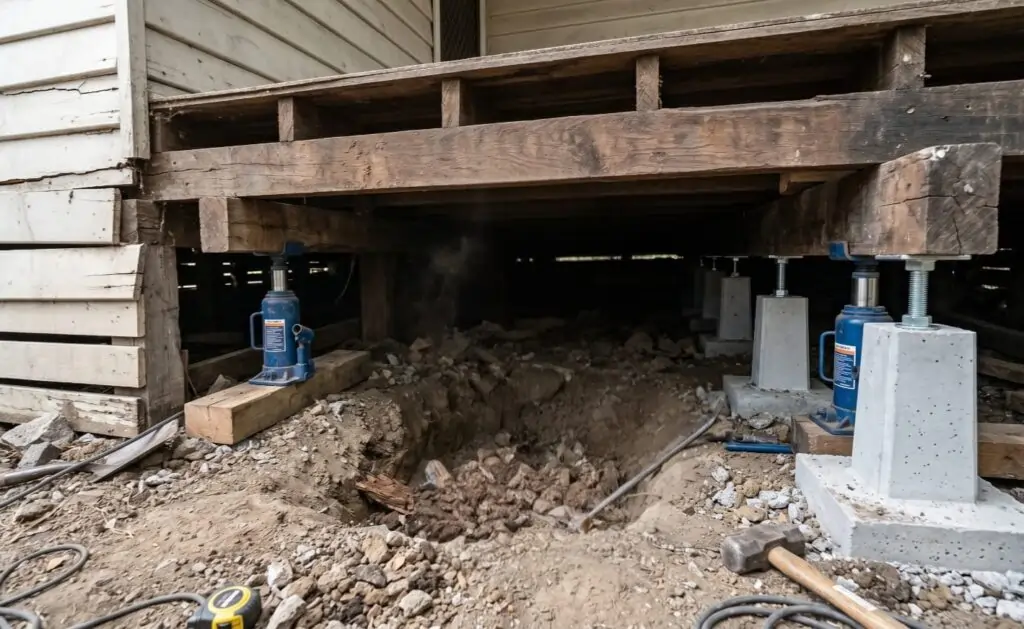
Before removing old stumps, the contractor installs temporary acrow props or beams to support the floor structure. This keeps the home structurally safe throughout the process.
Step 4: Stump Removal
Old, deteriorated stumps are carefully removed. In some cases this involves excavation beneath the bearers to expose the stump base.
Step 5: New Stump Installation
New concrete or steel stumps are installed, set to the correct height and level. Where concrete stumps are used, they are typically cast in situ or pre-cast units are set in concrete footings.
Step 6: Floor Levelling and Final Inspection
Once stumps are set, temporary supports are removed and the floor is checked for level. A final building inspection is completed by the building surveyor to issue an occupancy permit or certificate of final inspection.
Throughout this process, most homeowners can remain in the property. However, your contractor should confirm this based on the specific scope and access requirements of your job. For complex or full restumping projects, some short-term disruption to specific rooms may be necessary.
To learn more about the full scope of subfloor and foundation work available in Melbourne, the VIC Wide reblocking service page covers the process in detail.
Building Permits and Council Approvals for Restumping in Melbourne
A common question from Melbourne homeowners is whether council approval is needed for restumping. The short answer is that a building permit — not council planning approval — is almost always required. These are two different things.
A building permit is issued by a registered building surveyor (either private or council) and confirms that the proposed work complies with the National Construction Code and the Building Act 1993 (Vic). This permit is separate from a planning permit, which relates to land use and development.
Verified Fact — Building Permits in Victoria
Restumping is a structural building activity that requires a building permit under the Building Act 1993 (Vic) in most cases. Your registered building practitioner should obtain this permit on your behalf before any work begins. Source: Victorian Building Authority — Building Permits.
Any contractor who tells you a building permit is not needed for restumping in Melbourne should be questioned closely. Skipping the permit creates significant risks — including the possibility of having to remove and redo unpermitted work at your own expense if the property is ever sold, refinanced, or inspected by a building surveyor.
For further information on permits and regulations, Consumer information on building permits is available directly from the VBA.
Frequently Asked Questions About Restumping in Melbourne
Final Thoughts: Making the Right Call on Restumping in Melbourne
Choosing the right contractor for restumping in Melbourne comes down to three things: credentials, clarity, and communication. A registered building practitioner who provides a detailed written quote, a clear warranty, proper permits, and transparent insurance coverage is the only type of contractor worth hiring for this kind of structural work.
Furthermore, take the time to compare at least three quotes before committing. Read those quotes carefully. Ask about fixed pricing. Confirm VBA registration independently. And pay close attention to any red flags — because the consequences of poor restumping work are structural, financial, and legally complex to resolve.
Melbourne’s housing stock is ageing, and its reactive clay soils are unforgiving. Addressing stump failure early, through qualified professionals, is the most cost-effective decision a homeowner can make. Whether you need a full restump, partial replacement, an underpinning assessment, or simply an expert subfloor inspection to understand what is happening beneath your floors, the right advice starts with speaking to a licensed and experienced team.
VIC Wide serves Melbourne homeowners with registered, insured restumping and reblocking services. Get in touch today to arrange a professional assessment and a no-obligation written quote.