

If your floors have started to slope or your doors no longer close smoothly, your home may need house restumping. In Melbourne, this is one of the most common structural repairs for older properties – and one of the most misunderstood. Costs for restumping in Melbourne typically range from $150 to $400 per stump as of 2026, though the total price depends heavily on your home’s size, the stump material chosen, and the condition of Melbourne’s notoriously reactive clay soil beneath your property. This guide walks you through everything you genuinely need to know before calling a contractor.
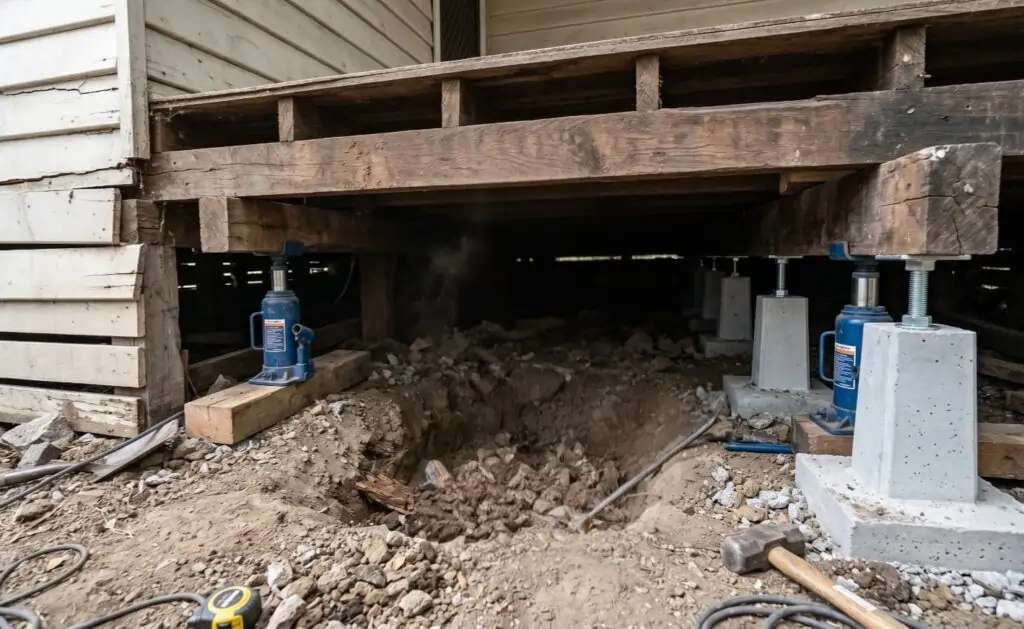
Restumping – sometimes called reblocking – means replacing the vertical supports that hold your home above the ground. Most Melbourne homes built before the 1980s sit on timber stumps. Over time, those stumps rot, shift, or sink. When that happens, the entire floor system moves with them. Consequently, walls crack, doors bind, and floors become uneven.
It is not a cosmetic issue. Moreover, left untreated, deteriorating stumps lead to genuinely serious structural damage that costs far more to fix later.
According to Wikipedia’s overview of foundation engineering, the primary purpose of a building foundation is to transfer structural loads safely to the ground beneath. When stumps fail, that transfer breaks down – and everything above ground suffers as a result.
How Melbourne Clay Soil Drives Foundation Problems
Melbourne’s soil is one of the biggest reasons restumping is so common here. The city sits largely on reactive clay – soil that swells when wet and shrinks when dry. Furthermore, that constant movement puts enormous stress on stumps over decades.
During summer droughts, the clay contracts. Then winter rains arrive and the ground swells again. Each cycle shifts the stumps incrementally. Over 40 or 50 years, this adds up to significant movement beneath your floor.
Additionally, the tree root systems in older Melbourne suburbs can draw moisture from beneath homes. This causes uneven drying beneath the slab or subfloor. As a result, one section of the house may sink while another stays level.
Understanding foundation repairs in Melbourne means understanding that soil is not a passive element. It actively pushes and pulls at your home’s structure year after year.
Warning Signs Your Home May Need Attention
Many Melbourne homeowners only discover foundation problems when the damage is already advanced. However, the early signs are usually visible – if you know what to look for. Below are the key indicators that your home’s stumps deserve a professional inspection.
Uneven or sloping floors –
One area sits higher than another, or you notice a gentle slope across a room.
Bouncy or springy floors –
The floor flexes underfoot in a way it never used to.
Cracks in walls or ceilings – Particularly diagonal cracks running from the corners of doors and windows.
Doors and windows that stick – Frames warp or shift when stumps sink unevenly.
Visible gaps between floors and walls –
A clear sign that the structure has moved.
Home is pre-1980s –
Most homes from this era have original timber stumps that are now at or past their expected lifespan.
Notably, diagonal cracks near door and window corners are one of the most reliable indicators of differential foundation movement. These cracks follow the lines of least resistance in the wall structure. Therefore, if you spot them, do not simply fill them and move on. Instead, get the stumps inspected.
If your home was built before 1980 and you have not had a foundation assessment recently, it is worth arranging a free consultation and advice session to understand the current condition of your stumps.
Stump Materials Compared – Timber, Concrete and Steel
When it comes to reblocking in Melbourne, one of the biggest decisions is which stump material to use. Each option comes with different costs, lifespans, and suitability for different soil types. Here is a clear comparison.
Timber Stumps
- Lowest upfront cost
- Lifespan: 25-40 years
- Susceptible to rot and termites
- Not recommended for high-moisture sites
- Traditional choice in Melbourne’s older suburbs
- Requires periodic inspection
Concrete Stumps
- Mid-range cost
- Lifespan: 40-80 years (approx.)
- Resistant to rot and termites
- Can crack under extreme soil movement
- Very common choice in Melbourne today
- Adjustable screw-top versions available
Steel Stumps
- Higher upfront cost
- Lifespan: 50+ years with treatment
- Strong and termite-proof
- Can corrode without proper treatment
- Excellent for high-movement sites
- Adjustable screw versions very popular
Adjustable steel or concrete stumps are increasingly popular across Melbourne. They allow fine-tuning after installation – a useful feature given the ongoing seasonal movement from reactive clay. Consequently, many licensed restumpers in Melbourne now recommend them as standard.
Your choice of material should reflect your soil class, your budget, and the long-term plan for the property. A qualified consultation can help you make an informed decision before you commit to anything.
Note on lifespan figures: Stump lifespans depend on soil conditions, moisture, site drainage, and maintenance. The figures above are general industry estimates and should not replace an assessment by a licensed practitioner on your specific property.
Restumping vs Underpinning – Choosing the Right Fix for Your Home
Melbourne homeowners often confuse restumping with underpinning. Both address foundation problems. However, they work very differently – and one is not a substitute for the other.
Restumping (or reblocking) applies specifically to homes built on stumps. The stumps are removed and replaced. This is the appropriate solution when stumps have deteriorated due to age, rot, or pest damage.
Underpinning, on the other hand, strengthens or deepens an existing foundation. It suits homes on slab foundations, or where the soil beneath has shifted and the existing foundation needs to reach more stable ground below.
“A restumper replaces what is failing above the ground. An underpinner stabilises what is happening below it. Both are structural interventions that require a licensed practitioner.” – VIC Wide Foundation Specialists
In some cases, a home may need both. For example, a property might have deteriorated stumps in one area and unstable soil causing subsidence in another. Therefore, the right approach starts with an honest, thorough inspection – not with a contractor recommending their preferred service before they have looked at your home.
If you are unsure which solution applies to your property, book a free consultation to get an expert opinion before making any decisions.
Restumping Costs and How to Get Fair Quotes in Melbourne
Understanding restumping costs in Melbourne takes some context. There is no single fixed price that applies to every home. However, transparency matters – and any reputable contractor should give you a clear written breakdown before any work begins.
What Affects the Cost of Restumping in Melbourne?
Several factors influence the total price of a restumping job. Knowing these upfront helps you evaluate quotes more accurately.
- Number of stumps – A larger home has more stumps. Partial restumping costs less than a full job.
- Stump material chosen – Timber is cheapest; steel is the most expensive. Concrete sits in the middle.
- Access difficulty – Tight subfloor spaces or restricted site access increase labour time and cost.
- Soil conditions – Highly reactive clay or poor drainage may require additional ground preparation.
- Permit requirements – In Victoria, building permits may be required depending on the scope of work.
- Levelling requirements – If the floor needs significant re-levelling, this adds time and cost.
Price Range – As of June 2026
- Restumping cost per stump in Melbourne: approximately $150 to $400 per stump
- Full restump of an average 3-bedroom Melbourne home: approximately $10,000 to $30,000+
- Partial restumping (selected stumps only): $3,000 to $8,000 depending on number and material
Disclaimer: These figures are general market estimates only as of June 2026 and may vary based on site-specific conditions, materials, scope, and contractor. Always obtain a fixed price written quote from a licensed restumper before committing to any work. Prices are subject to change.
How to Get Restumping Quotes in Melbourne – and Compare Them Properly
Getting multiple restumping quotes in Melbourne is not just smart – it is essential. Here is how to approach the process so you end up with a fair deal from a trustworthy contractor.
- Get at least three written quotes. This gives you a realistic sense of the market rate in Melbourne for your specific scope of work.
- Insist on a fixed price quote. A fixed price restumping quote removes the risk of unexpected cost blowouts. If a contractor refuses to give one, that is a warning sign.
- Ask what is included. A proper quote should specify the number of stumps, stump material, labour, any permit fees, site preparation, and cleanup. Understanding what is included in a restumping quote helps you compare like for like.
- Check the warranty. Ask each contractor what restumping warranty they offer in Melbourne. Reputable companies stand behind their work with a written guarantee.
- Verify VBA registration before signing anything. More on that below.
Beware of unusually cheap restumping quotes. Cheap restumping in Melbourne can be a warning sign of unlicensed labour, substandard materials, or a contractor who will find reasons to add costs once work has begun. If a quote is significantly lower than others, ask specifically why.
Free Quote Disclaimer: Free quotes from VIC Wide are available for properties within a 50km radius of Mill Park, in the Northern suburbs of Melbourne. Properties outside this area will incur a $50 assessment fee for the quote.
Choosing a Licensed Restumper in Melbourne – What to Look For
Selecting the right contractor is as important as understanding the work itself. In Victoria, residential building work including restumping must generally be carried out by a registered building practitioner. The Victorian Building Authority (VBA) maintains this register and it is publicly searchable.
Specifically, look for a contractor who holds a valid VBA registration. This is not a formality. It means they are accountable to a regulatory body, carry appropriate insurance, and meet the technical standards required by law in Victoria.
What Else Should You Ask a Contractor Before Hiring?
- Are you currently registered with the VBA? (Ask for their registration number.)
- Are you fully insured for this type of work?
- Do you handle permit applications where required?
- What restumping warranty do you provide in Melbourne – and is it in writing?
- Can you provide references from recent Melbourne jobs?
- Is your quote a fixed price, or is it an estimate subject to change?
- How do you handle unexpected issues found during the job?
A licensed and insured restumper in Melbourne should answer every one of those questions clearly and confidently. Furthermore, they should welcome the scrutiny rather than deflect it.
When reviewing restumping company reviews in Melbourne, look beyond the star rating. Read the detailed reviews carefully. Specifically, pay attention to comments about communication, cleanliness, whether the final price matched the quote, and how issues were handled when they arose.
Red Flags When Hiring a Restumping Contractor
Unfortunately, not every contractor operating in Melbourne meets the standard you deserve. Knowing the red flags when hiring a restumping contractor can protect you from a costly mistake. Here is what to watch for.
- No VBA registration number provided when asked
- Refuses to give a fixed price written quote
- Pressure to sign immediately before you have time to compare quotes
- No mention of building permits where they are legally required
- Quote significantly cheaper than all others without a clear explanation
- No warranty offered in writing
- Cannot provide references from recent Melbourne restumping jobs
- Vague or verbal-only scope of work with no written breakdown
- Requests full payment upfront before any work begins
- No mention of insurance coverage
Additionally, be cautious of contractors who claim your home requires a full restump without first performing a thorough inspection. A reputable professional will assess the actual condition of each stump before recommending the scope of work. Consequently, partial restumping may be all that is needed – and a trustworthy contractor will tell you that honestly.
The VIC Wide Restumping Process – From Inspection to Completion
At VIC Wide, we believe homeowners deserve clarity at every stage. Therefore, our process is designed to be transparent, low-disruption, and straightforward. Here is exactly what to expect when you contact us about reblocking or foundation repairs in Melbourne.
Free Inspection
We come to your home at no cost. We thoroughly inspect your foundation, stumps, and structure for any issues.
Detailed Assessment
We explain what we found in plain English with no confusing jargon. You will understand exactly what is happening and why.
Clear Quote
You get a detailed written quote with no hidden costs. We break down everything so you know exactly what you are paying for.
Expert Work
Our experienced team carries out the repairs with minimal disruption. We respect your home and leave it tidy every day.
Final Walkthrough
We walk you through the completed work, answer any questions, and make sure you are 100% happy before we leave.
That structure means you are never left guessing. Additionally, our team communicates throughout the job so there are no surprises on the final invoice. If something unexpected comes up during the work, we discuss it with you before proceeding – never after.
Frequently Asked Questions About House Restumping
Below are the most common questions Melbourne homeowners ask about house restumping, reblocking, and foundation repairs. Each answer is concise and practical.
Conclusion – Protecting Your Melbourne Home Starts With the Foundation
House restumping in Melbourne is not something to delay. If you have spotted the warning signs – sloping floors, sticking doors, diagonal cracks, or a pre-1980s home that has never been assessed – the right move is to get a professional inspection now. The longer foundation problems are left unaddressed, the more extensive and expensive the eventual repair becomes. Furthermore, a structurally sound foundation protects both your family’s safety and your property’s long-term value.
The key takeaways from this guide are straightforward. First, understand the signs before they become serious damage. Second, choose a licensed and insured restumper in Melbourne with a verifiable VBA registration. Third, get at least three fixed price written quotes and know exactly what is included. Fourth, ask about the warranty in writing. Finally, do not treat the cheapest quote as the best deal – scrutinise what each quote actually covers.
At VIC Wide, we offer free inspections, honest assessments in plain English, and fixed price quotes with no hidden costs. Our team is fully registered and works across Melbourne’s northern suburbs and surrounding areas. We handle reblocking, underpinning, foundation repairs, and consultation and advice for Melbourne homeowners who want clarity before they commit.
If your home is showing any of the signs discussed above, do not wait. Instead, reach out today and let us assess the situation – at no cost and with no pressure.
Disclaimer: The information in this article is general in nature and does not constitute professional structural engineering or building advice. Always consult a licensed and registered building practitioner before making decisions about your home’s foundation. Price ranges stated are approximate estimates as of June 2026 and are subject to change. VIC Wide accepts no liability for decisions made based on general information contained in this article.