

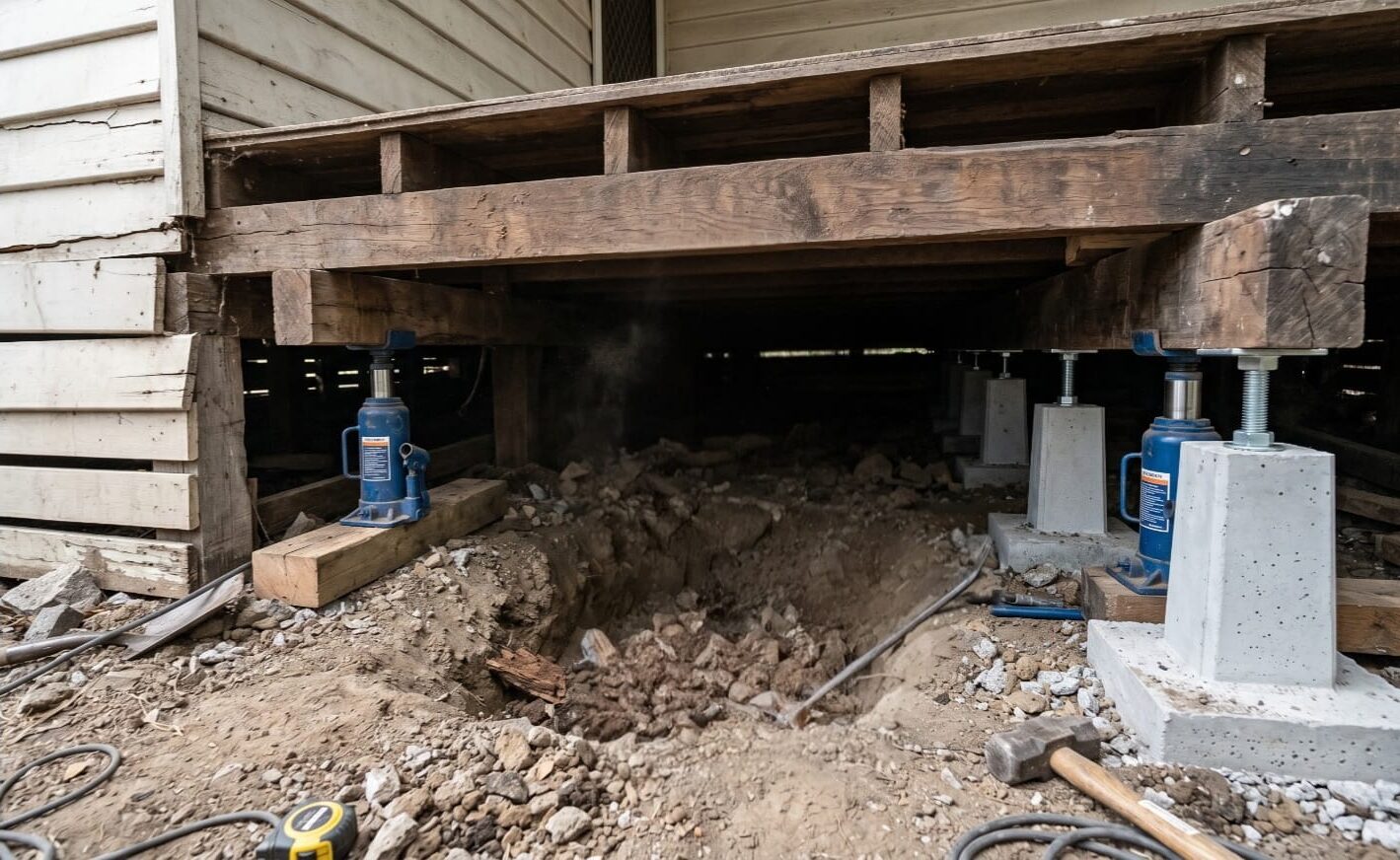

If you own a home in Box Hill, restumping is probably not the first thing on your mind every morning. But here is the uncomfortable truth: beneath many weatherboard homes across the eastern suburbs, timber stumps are quietly rotting away. They have been doing it for decades. And when they finally give way, the signs are impossible to ignore.
Floors start to slope. Doors stick in their frames for no obvious reason. Cracks appear across walls and ceilings. That springy feel underfoot gets worse each year. These are not cosmetic problems. They are structural warnings, and every month you delay makes the repair more expensive.
This guide walks you through exactly what happens when timber stumps fail under a Box Hill home, what restumping involves, what it costs, and how to get it sorted without the stress.
Why Box Hill Homes Are Particularly Vulnerable to Stump Failure
Box Hill sits within Melbourne’s middle-eastern ring, where thousands of timber-framed homes were built between the 1920s and the 1970s. Most of these homes rest on hardwood timber stumps driven into reactive clay soil. That combination creates an ongoing problem.
Melbourne’s clay soils expand significantly when wet and shrink during dry summers. This constant cycle of soil movement shifts the load on subfloor stumps repeatedly throughout every year. Over time, even well-driven stumps start to lean, crack, or rot at the base where moisture concentrates.
Homes along Box Hill’s older streets, particularly properties built before 1960, were constructed using untreated hardwood stumps. These stumps had no chemical protection against moisture or termites. Frankly, they were never expected to last a century, and many of them have already exceeded their intended lifespan.
Verified Fact – Victorian Building Authority
According to the Victorian Building Authority (VBA), all restumping work in Victoria requires a building permit and must be carried out by a registered domestic builder. Unregistered work is not only illegal but also invalidates home sale disclosures. Source: vba.vic.gov.au
Eastern suburbs Melbourne suburbs like Box Hill, Blackburn, Nunawading, and Mitcham share nearly identical soil profiles and housing stock ages. That means the stump deterioration issues are widespread across the region, not isolated to a single street or suburb.
Warning Signs That Timber Stumps Are Failing Beneath Your Home
Here is where most Box Hill homeowners get caught out. Timber stump failure is gradual. It rarely announces itself dramatically. Instead, it creeps up through a series of symptoms that are easy to dismiss as general ageing of the home.
Floors That Slope or Feel Springy
Place a marble on a hard floor surface. If it rolls without a push, your floor is no longer level. A springy or bouncy feel underfoot is an equally clear signal that subfloor supports are compromised beneath that area.
Doors and Windows That Stick or Jam
When stumps sink unevenly, the structural frame shifts. Door frames go out of square. Windows become difficult to open or close. This is one of the most reliable early indicators of stump movement under a timber-framed Box Hill home.
Cracks in Walls, Cornices, and Ceilings
Diagonal cracks appearing at the corners of door frames and windows are a classic sign of foundation movement. Horizontal cracks along cornices often accompany sagging in the subfloor structure below. Not all cracks indicate restumping need, but recurring cracks in predictable locations are worth investigating properly.
Visible Rot or Lean in Subfloor Stumps
If you have subfloor access, grab a torch and have a look. Stumps that have rotted at the base, leaned visibly off-centre, cracked horizontally, or developed hollow sections need attention. A licensed building inspector can assess which stumps are failing and whether partial or full replacement is needed.
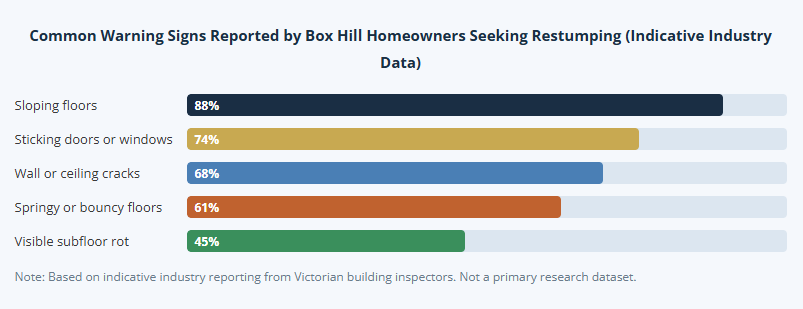
Spotted some of these signs at home? Explore Vic Wide’s reblocking service page to understand what a professional inspection involves before you call.
How Long Timber Stumps Actually Last Under a Melbourne Home
This question comes up repeatedly on Australian renovation forums, and the honest answer is: it depends on a lot of factors. Timber species, soil moisture, drainage quality, and termite activity all influence stump lifespan significantly.
Generally speaking, untreated hardwood timber stumps in Melbourne’s clay-heavy eastern suburbs last between 20 and 40 years. Some last longer in dry, well-drained conditions. Others deteriorate in under 15 years when moisture sits around the base consistently.
“Many Box Hill homes built in the 1950s and 1960s are now sitting on stumps that are 60 to 70 years old. That is well beyond the expected service life of untreated hardwood in Melbourne’s reactive soil conditions.”
Treated pine stumps introduced from the 1980s onward have better moisture resistance. However, they still degrade over time, particularly when subfloor ventilation is poor or when termite activity goes undetected for several years.
Concrete stumps, by contrast, are effectively permanent in the subfloor environment. They do not rot, absorb moisture, or attract termites. This is precisely why modern reblocking in eastern suburbs Melbourne almost always uses concrete stumps as the replacement material.
The Restumping Process for Box Hill Properties
Understanding what actually happens during restumping removes most of the anxiety surrounding the job. It is more methodical and less disruptive than most homeowners expect.
Step 1 – Inspection and Assessment
A licensed inspector or restumping contractor assesses the subfloor condition. They identify which stumps are failing, measure floor levels throughout the home, and determine whether partial or full restumping is appropriate. This assessment informs the permit application.
Step 2 – Building Permit from Whitehorse Council
Restumping in Box Hill requires a building permit through Whitehorse City Council. Your registered contractor handles this submission. Work cannot begin legally until the permit is issued and a building surveyor is appointed to oversee the project.
Step 3 – House Lifting and Temporary Support
The contractor uses hydraulic jacks to carefully lift sections of the home. Temporary acrow props support the floor frame during stump removal. This stage requires precision. Lifting too fast or unevenly can cause additional cracking in the structure above.
Step 4 – Old Stump Removal and New Installation
Old timber stumps are removed, including any decayed root sections. New concrete stumps are installed to the correct depth and level. The base pad beneath each stump is assessed to ensure adequate load-bearing capacity in the soil.
Step 5 – Lowering, Levelling, and Final Inspection
Once all new stumps are set, the home is carefully lowered onto the new foundation. Final floor levels are checked and adjusted. The appointed building surveyor conducts a mandatory final inspection before the permit is closed.
| Stage | Who Is Responsible | Typical Duration |
|---|---|---|
| Initial Inspection | Registered Contractor or Building Inspector | Half a day |
| Permit Application | Contractor (Whitehorse Council) | 5 to 15 business days |
| House Lifting and Propping | Restumping Crew | Day 1 |
| Stump Removal and Replacement | Restumping Crew | Day 1 to Day 3 |
| Lowering and Levelling | Restumping Crew | Day 3 to Day 4 |
| Final Surveyor Inspection | Appointed Building Surveyor | Half a day |
Concrete vs Timber vs Steel: Choosing the Right Stump for Box Hill
The material choice for replacement stumps matters more than most homeowners realise. Each option has its strengths, and the right choice depends on your soil conditions, budget, and long-term plans for the property.
Concrete Stumps
Concrete stumps are the most widely used replacement option in eastern suburbs Melbourne. They are durable, termite-proof, and require no ongoing maintenance. In Box Hill’s reactive clay soil, concrete stumps handle seasonal moisture variation without degrading. Their lifespan effectively exceeds the life of the home itself when installed correctly.
Adjustable Steel Stumps
Adjustable steel stumps suit homes on highly reactive soils where ongoing floor movement is expected. They can be adjusted post-installation to correct minor level changes over time. However, they cost more upfront and require periodic checking. They are a practical option for homes on particularly problematic soil profiles in the eastern suburbs.
Treated Timber Stumps
Treated pine stumps are occasionally used in partial restumping jobs or where budget is a primary constraint. They last significantly longer than untreated hardwood but still carry a finite service life. Most experienced contractors in Box Hill recommend concrete as the priority choice for full restumping projects.
| Stump Type | Lifespan | Termite Resistance | Adjustable | Cost Range |
|---|---|---|---|---|
| Concrete | Effectively permanent | Yes | No | Mid to high |
| Adjustable Steel | 40 to 60+ years | Yes | Yes | High |
| Treated Timber | 25 to 40 years | Moderate | No | Lower |
For most Box Hill homeowners undertaking a full restumping project, concrete stumps deliver the best long-term value. The investment pays off across decades of structural stability without repeat repairs.
What Restumping Costs in Box Hill, Melbourne
Cost is almost always the first question. The honest answer is that restumping prices vary significantly depending on several factors. Any quote under $8,000 for a full house should raise questions about stump count, material quality, and permit compliance.
Key Factors Driving Restumping Cost in Box Hill
- Number of stumps: A typical weatherboard home in Box Hill has between 40 and 100 stumps. More stumps mean more labour and materials.
- Partial vs full restumping: Replacing 15 to 30 failing stumps costs less than a full house reblock.
- Subfloor access: Low clearance subfloors take longer to work in and increase labour costs.
- Stump material choice: Concrete stumps cost more than treated timber but last indefinitely.
- Soil conditions: Heavily reactive or waterlogged soil may require additional base preparation work.
- Permit and inspection fees: Building permits through Whitehorse Council add to the total project cost.
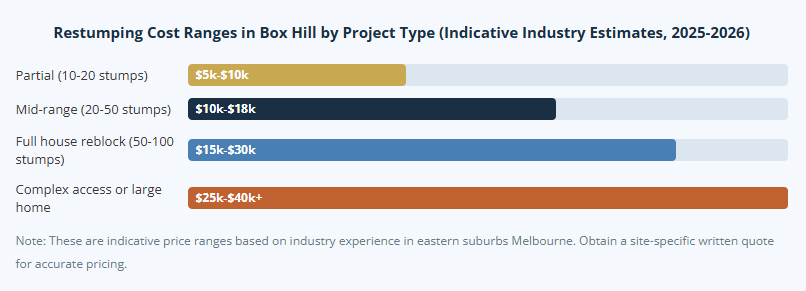
Always request a written, itemised quote. It must include permit fees, surveyor costs, material specifications, stump count, and warranty terms. A reputable contractor in Box Hill will provide this without hesitation.
Permits, Inspections, and Whitehorse Council Requirements for Restumping
This is one area where Box Hill homeowners sometimes get caught out. Restumping is not a simple handyman job. It is classified as structural building work under the Building Act 1993 (Vic), and it legally requires a building permit in every case.
In Box Hill, building permits for restumping work must be issued and processed by a private registered building surveyor. While your contractor can prepare the documentation on your behalf, you must formally appoint the surveyor under Victorian law.
Verified Fact – Building Act 1993 (Vic)Under Section 16 of the Building Act 1993 (Vic), it is an offence to carry out building work without a building permit where one is required. Restumping and reblocking of residential structures falls within this requirement. Fines apply to both the owner and the builder for unpermitted structural work. Source: Victorian Legislation – Building Act 1993
Once the permit is issued, an appointed building surveyor conducts mandatory inspections at key stages, including a final inspection before the permit is closed out. This mandatory oversight protects you as the homeowner and ensures the work meets the National Construction Code standards.
Avoid any contractor who offers to complete restumping without a permit. It might seem cheaper upfront, but unpermitted structural work creates serious problems when you sell the property and during any future insurance claims.
Not sure where to start with permits? Contact the Vic Wide team — they manage the full permit process on your behalf from initial inspection through to final council sign-off.
How to Choose a Trustworthy Restumping Contractor in Box Hill
The eastern suburbs Melbourne market has no shortage of tradespeople offering reblocking quotes. Unfortunately, not all of them operate to the same standard. Choosing the wrong contractor can leave you with a poorly levelled home, unpermitted work, or a bill for repairs that never actually fixed the root problem.
Here is what to check before signing anything.
- VBA Registration: Verify the contractor’s registration number on the Victorian Building Authority website at vba.vic.gov.au. Never engage an unregistered builder for restumping work.
- Local Eastern Suburbs Experience: A contractor familiar with Box Hill’s soil conditions, council permit processes, and typical weatherboard subfloor configurations will do a better job than a generalist.
- Written Itemised Quotes: Any legitimate contractor provides a full written quote. Walk away from verbal estimates only.
- Permit Inclusion: Confirm that the quote includes or accounts for permit fees and surveyor costs. These should not be surprise additions later.
- Warranty on Workmanship: Ask about the warranty period on the restumping work itself. Reputable contractors stand behind their work with a documented warranty.
- Insurance Coverage: Confirm the contractor holds current public liability and domestic builder insurance.
Vic Wide Reblocking and Underpinning operates across Box Hill and the eastern suburbs with full VBA registration, transparent written quotes, and permit management included. Get in touch at 1300 296 939 or visit vic-wide.com.au to learn more about the team and their approach.
More Services Worth Knowing About
Restumping is not always the only structural issue a Box Hill home faces. Depending on the age and condition of the property, additional foundation services may be relevant. These include:
- Underpinning services for homes where footing depth is insufficient for the current soil conditions.
- Foundation repair services for homes experiencing more complex structural movement beyond stump failure alone.
- Structural consultation and advice if you are unsure whether your home needs restumping or a different intervention entirely.
Since you have stuck around this far, here is your reward: the full Vic Wide services overview at vic-wide.com.au covers everything from reblocking to underpinning to foundation repair — worth a squiz before you decide what your home actually needs.
Frequently Asked Questions About Restumping in Box Hill
How do I know if my Box Hill home needs restumping?
Look for sloping floors, sticking doors, cracking walls, or a springy feel underfoot. A licensed building inspector can confirm stump deterioration beneath your subfloor through a proper inspection.
How much does restumping cost in Box Hill, Melbourne?
Costs in Box Hill typically range from $8,000 for partial restumping up to $30,000 or more for a full house reblock. The final price depends on stump count, material choice, subfloor access, and permit fees.
How long do timber stumps last under a Melbourne home?
Untreated hardwood stumps typically last 20 to 40 years in Melbourne’s reactive clay soil. Moisture concentration at the base and termite activity can shorten this lifespan considerably in eastern suburbs properties.
What is the difference between restumping and reblocking in Victoria?
There is no difference. Both terms describe the same process of replacing deteriorated subfloor stumps with new concrete or treated timber stumps to re-level and stabilise the home’s structure.
Can I stay in my house during restumping in Box Hill?
In most cases, yes. Most Box Hill restumping jobs allow residents to remain in the home throughout the process. Your contractor will advise if any safety stage requires temporary relocation.
Should I replace timber stumps with concrete or adjustable steel stumps?
Concrete stumps are the industry standard for most Box Hill homes. They are durable, termite-proof, and permanently stable. Adjustable steel stumps suit properties on highly reactive soils needing ongoing floor level correction.
Do I need a building permit to restump my Box Hill home?
Yes. Victorian building law requires a building permit for all restumping work in Box Hill. Your registered contractor prepares the documentation for a private registered building surveyor to review and issue.
Will my homeowner’s insurance cover restumping in Box Hill?
Most standard home insurance policies do not cover restumping. Gradual timber deterioration is classified as maintenance wear, not accidental damage. Check your specific policy directly with your insurer to confirm your coverage.
How many stumps does a typical Box Hill home have, and how many need replacing?
A typical Box Hill weatherboard home has between 40 and 100 stumps depending on its size and floor plan. Partial restumping may address 10 to 30 failing stumps. Full reblocking replaces every stump in the property.
How do I find a trustworthy restumping contractor in Box Hill?
Check for VBA registration at vba.vic.gov.au, request a written itemised quote, confirm permit inclusion, and verify local eastern suburbs Melbourne experience. Never engage an unregistered builder for structural work.
How long does a full restumping job take in Box Hill?
Most full restumping jobs in Box Hill take between two and five working days on-site. Permit approval adds time before work can legally begin, typically five to fifteen business days depending on council processing.
What happens if I ignore rotting stumps under my Box Hill home?
Ignoring rotting stumps accelerates floor slope, wall cracking, door misalignment, and structural frame damage. The problem does not pause or self-correct. Delay consistently increases both repair complexity and total cost.
Is restumping the same as underpinning?
No. Restumping replaces subfloor stumps on homes built on a stumped foundation system. Underpinning deepens or reinforces the concrete slab or strip footings of a different foundation type. Both address structural instability but through different methods.
Conclusion: Do Not Wait for the Floor to Tell You Twice
Restumping in Box Hill is not a glamorous home improvement project. It is not the kind of thing you post on Instagram. But it is arguably one of the most important structural repairs a homeowner in the eastern suburbs can make.
Timber stumps have a finite life. Melbourne’s reactive clay soil accelerates their decline. And the longer a failing subfloor goes unaddressed, the more damage spreads through the structure above. Every sloping floor, sticking door, and wall crack is telling you something your subfloor already figured out months ago.
The good news is that restumping in Box Hill is a well-understood, manageable process. The right contractor, the right materials, and a proper Whitehorse Council permit deliver a structurally stable home that will serve your family for decades without ongoing subfloor concerns.
If your Box Hill home was built before 1980, booking a subfloor inspection is a genuinely wise move. It costs far less than a full restumping job — and it tells you exactly what you are dealing with before the problem gets worse.